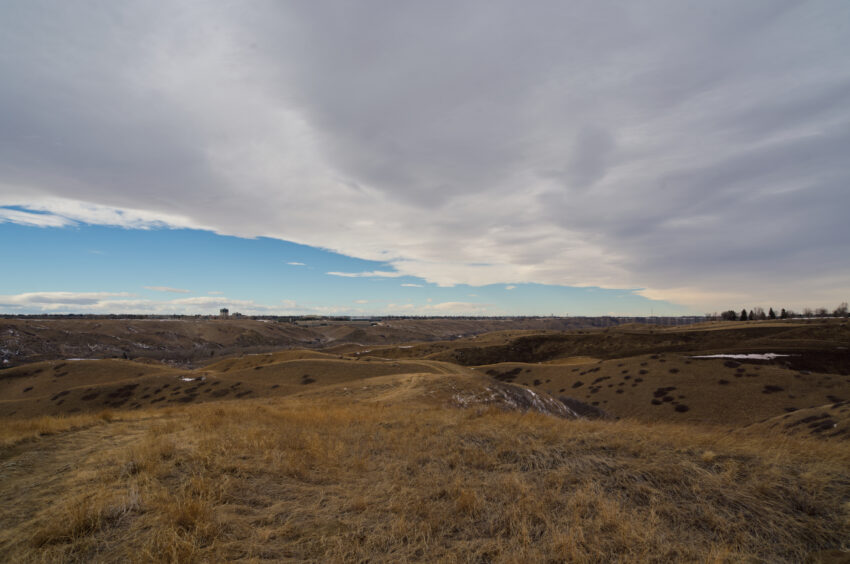
Chinook winds are a fascinating phenomenon experienced in the eastern Rocky Mountains and western Canadian Prairies and Great Plains. Learn about their formation, effects, and more!
What is a Chinook?
Chinooks are strong, warm, dry, westerly winds that occur on the leeward side of the Rocky Mountains and cause sudden warming. Chinooks occur due to the geography of the Rockies themselves, and this phenomenon has wide ranging impacts on the ecosystems and people that call the foothills home.
Air currents, known as westerlies, carry moist air from the Pacific eastward into the continent’s interior. When this oceanic wind reaches the Rockies, the air is forced upwards and over the barrier. This process is known as orographic lift — from the Greek word for mountain, oros.
The air cools as it rises, causing moisture to condense into clouds and fall as precipitation on the windward side of the mountains. The now-dry air mass crests the mountain range, and travels down the leeward side of the mountains. As it descends, increasing atmospheric pressure compresses the air, which warms it.
This warm, dry, downslope wind is a Chinook.
In some cases temperatures can rise by 25°C in a matter of hours due to chinooks, but how? According to the Canadian Encyclopedia, an increase of 27°C in two minutes has been observed during a chinook. Earlier in February, Canada experienced its first 20°C day of 2026 in Lethbridge, Alberta — this exceptionally warm winter weather was brought on by chinook winds.
A few factors contribute to this stark spike in temperature:
Water condensing on the windward side of the mountains returns latent heat to the air mass — though this only warms the air slightly.
The downslope wind warms as it travels down the leeward side of the range. As chinook winds descend the eastern Rockies, the increase in atmospheric air pressure compresses the chinook air mass — causing it to warm quickly. This warming occurs adiabatically (see note below), and is the primary cause of warming during a chinook.
However, chinook winds in Alberta often replace cold arctic air that originates in the north, exacerbating temperature changes caused by chinooks.
Diabatic processes cause heating or cooling as the result of heat exchange from one source to another (such as the sun transferring heat to the Earth). In adiabatic processes, temperature change occurs without heat transfer due to the compression (heating) or expansion (cooling) of an air mass.
Folklore
There is very little information available online regarding Indigenous folklore surrounding chinooks. The Blackfoot (Niitsitapi) are an Indigenous group that lives in the western Great Plains. One source claimed The Blackfoot word for chinooks translates to, “Snow-eater” — which they interpreted as a hot, dry and thirsty spirit that eats the snow.
However, I have been unable to find a copy of the film that this information is from to verify (The Snow Eater, 2003). If anyone knows where I can access this film, or knows Blackfoot folklore, please contact me.
Chinook Etymology
The word Chinook (shih-nook, /ʃɪˈnʊk/), originally pronounced Chinook (chi-nook, /tʃɪˈnʊk/), is the name of an Indigenous people who live near the Columbia river in the Pacific Northwest. This area experiences similarly gusty, warm winds, which French fur traders called Chinooks after the Indigenous people who lived in the region. Travelling with French fur-traders, the term was expanded to refer to the similar winds in the Columbia Plain and later the northwestern Great Plains.
While they use the same term, it’s worth noting that coastal and interior chinooks are caused by different processes — this article describes the process behind interior chinooks since those are what we get in Alberta.
Coastal chinooks (which are still pronounced ‘chi-nook’, or /tʃɪˈnʊk/) are warm, moist winds coming from the Pacific Ocean. Unlike interior chinooks, these winds bring with them abundant precipitation, which contributes to the climate of the Pacific Northwest and supports the regions temperate rainforests.
If you are curious and want to learn about some of the effects of coastal chinooks, I have a video that explores one of Canada’s temperate rainforests in the Columbia mountains of British Columbia.
Global Occurrence
Chinooks occur regularly in the eastern Rockies and foothills of Alberta, Montana and Wyoming (weather Channel). They occur year-round, but are most pronounced in the winter when temperature fluctuations are more noticeable.
While the term Chinook is exclusive to western North America, the phenomenon behind them is not. Similar winds are found around the world — occurring where wind currents blow perpendicular to mountain ranges. As a rule, the taller and steeper the mountains, the more pronounced the effect.
Similar winds from around the world:
- Suêtes (Cape Breton Island, Nova Scotia, Canada)
- Wreckhouse winds (Southwestern Newfoundland, Canada)
- Santa Ana winds (Southern California, United States)
- Mono winds (Sierra Nevada, California, United States)
- Brookings Effect (Southwestern Oregon, United States)
- Viento Zonda (Eastern Andes, Argentina)
- Puelche winds (Chile)
- Foehn/Föhn winds (European Alps)
- Favonia (Ticino & northwest Italy)
- Garbino (Adriatic coast, Italy)
- Fønvind (south & central Norway)
- Hnjúkaþeyr (Iceland)
- Helm wind (Pennines, Cumbria, England)
- Garmesh, Garmij, Garmbaad (Gilan Region, Iran)
- Laos wind (north & central Vietnam)
- Warm Braw (Schouten Islands, West Papua, Indonesia)
- Nor’wester (Hawkes Bay, Canterbury, & Otago, New Zealand)
- Great Dividing foehn (New South Wales, eastern Victoria, eastern Tasmania, Australia)
- Bergwind (Great Escarpment, South Africa)
- Föhn wall (Signy Island, South Orkneys, Antarctica)
All of these are caused by same combination of wind currents, orographic lift and adiabatic processes as interior Chinooks — they just go by different names. In many regions the term “foehn” has been borrowed and is used to describe regional winds.
Effects on the Environment
Chinook winds have an array of effects on the environment.
Before they’re felt, their effects can often be seen. These winds are turbulent, and when the undulating air flows upwards, any remaining moisture condenses high in the atmosphere creating a cloud formation commonly referred to as a chinook arch.
These massive blankets of condensing water over the foothills are even visible from space.
Chinook winds have an array of effects on the environment.
Before they’re felt, their effects can often be seen. These winds are turbulent, and when the undulating air flows upwards, any remaining moisture condenses high in the atmosphere at the crest of the rolling wave of wind. This creates a cloud formation commonly referred to as a chinook arch. These massive blankets of condensing water over the foothills are even visible from space.
In the alpine, Chinook winds redeposit fallen snow on leeward mountain ridges which can cause windslab avalanches. Slab avalanches are the most dangerous type of avalanche, and occur when snow accumulates and compacts forming a dense slab, which cleaves in massive sheets when snow layers aren’t adhered strongly.
Hot, dry chinook winds melt snow, desiccate plants, and dry and erode soil. It’s part of the reason why the eastern Rockies are so much drier than the western Rockies — though the rain-shadow effect also plays a role in the area’s aridity. Plants here are adapted to hot, dry, windy weather, and irrigation is vital for the region’s agriculture. Crop rotation is also utilized to help retain soil moisture and prevent wind erosion.
The high wind speeds brought by chinooks also make the Eastern Rockies a prime location for wind energy. Wind turbines can be spotted throughout southern Alberta, utilizing chinook winds to provide renewable energy to the regions populations.
Chinooks & Headaches
One interesting effect of chinooks is their association with headaches, migraines and other health issues. A study from the University of Calgary published in 2000 found that chinook winds increase the likelihood of migraines in some people. Though there was only an association between chinooks and migraines in half of the 75 individuals who took part in the study.
Scientists think that changes in barometric pressure from chinooks play a role in causing migraines. However, the results from studies are mixed. More research is needed to bolster the link between chinooks and headaches and determine a cause. Anecdotally, I do experience headaches and ear pain on windy chinook days, but cannot say if that’s caused by pressure changes, blowing winds, or some other factor.
There was also a retroactive study conducted in southern Bavaria which experiences similar foehn winds, which linked the foehns with increased risk of traumatic injury.
Nkemdirim, L.C. (2024). “Chinook.” The Canadian Encyclopedia. Accessed via https://www.thecanadianencyclopedia.ca/en/article/chinook
Gray, J. (2026). “Weather Words: Chinook Winds.” The Weather Channel. Accessed via https://weather.com/science/weather-explainers/news/2026-01-13-weather-words-chinook-winds
Karami, S. (2025). “Explaining the science behind the warmth and the chaos of Calgary’s Chinook winds.” The Calgary Journal. accessed via https://calgaryjournal.ca/2025/03/04/explaining-the-science-behind-the-warmth-and-the-chaos-of-calgarys-chinook-winds/
“Orographic Lift.” (N.D.). Modern Physics. Accessed via https://modern-physics.org/orographic-lifting/
West, G. & Howard, R. (2019). “UBC ATSC 113 — 6e Orographic Lift & Lee Shadowing.” University of British Columbia — Department of Earth, Ocean and Atmospheric Sciences. Accessed via https://www.eoas.ubc.ca/courses/atsc113/snow/met_concepts/06-met_concepts/06e-orographic-uplift-lee-shadowing/
CTV Your Morning (2018). “What is a chinook? | Ask Our Meteorologist.” YouTube. Accessed via https://www.youtube.com/watch?v=ak3OJZzlo-E&t=10s
“The Chinook Wind.” (1940). Oregon Historical Quarterly, volume 41, no. 1. Accessed via https://www.jstor.org/stable/20611244
Stone, L. (2024). “Chinook Winds, Explained.” Open Snow. Accessed via https://opensnow.com/news/post/chinook-winds-explained
Grotjahn, R. (2003). “Diabatic Process.” Science Direct. Accessed via https://www.sciencedirect.com/topics/earth-and-planetary-sciences/diabatic-process
“NOAA’s National Weather Service — Glossary.” (N.D.). NOAA. Accessed via https://forecast.weather.gov/glossary.php?word=adiabatic
“Defining The Adiabatic Process — What It Is And How It Occurs.” (N.D.). Own Your Weather. Accessed via https://ownyourweather.com/adiabatic-process/
“Explaining Chinook And Foehn Winds And How They are Formed.” (N.D.). Own Your Weather. Accessed via https://ownyourweather.com/chinook-and-foehn-winds/
“We officially hit 20 C in Canada Wednesday. Here’s where.” (2026). The Weather Network. Accessed via https://www.theweathernetwork.com/en/news/weather/forecasts/we-officially-hit-20-c-in-canada-today-heres-where
“Wind Slab.”(N.D.). National Avalanche Center. Accessed via https://avalanche.org/avalanche-encyclopedia/avalanche/avalanche-problems/avalanche-problem-type/wind-slab/
“Slab.” (N.D.). National Avalanche Center. Accessed via https://avalanche.org/avalanche-encyclopedia/snowpack/slab/
Said, A. (2025). “What’s the science behind chinook headaches? Experts still aren’t sure.” CBC Calgary. Accessed via https://www.cbc.ca/news/canada/calgary/chinook-winds-migraine-9.7015102
Read More

What are Chinook Winds?
Chinook winds are a fascinating phenomenon experienced in the eastern Rocky Mountains and western Canadian Prairies and Great Plains. Learn

Backyard Friends: Black-capped Chickadee
The Backyard Friends is a series about animal pals that you might find in your backyard. No matter where we

New Year Update!
We have started the new year, so I thought it would be a good time to give a little update