
The Backyard Friends is a series about animal pals that you might find in your backyard. No matter where we are, we are a part of the nature, not apart from it.
Table of Contents
Overview
Scientific name: Poecile atricapillus
Common name(s): Black-capped Chickadee, Carbonero Cabecinegro (Spanish), Mésange à Tête noire (French).
Conservation Status: Least Concern (Population Decreasing)
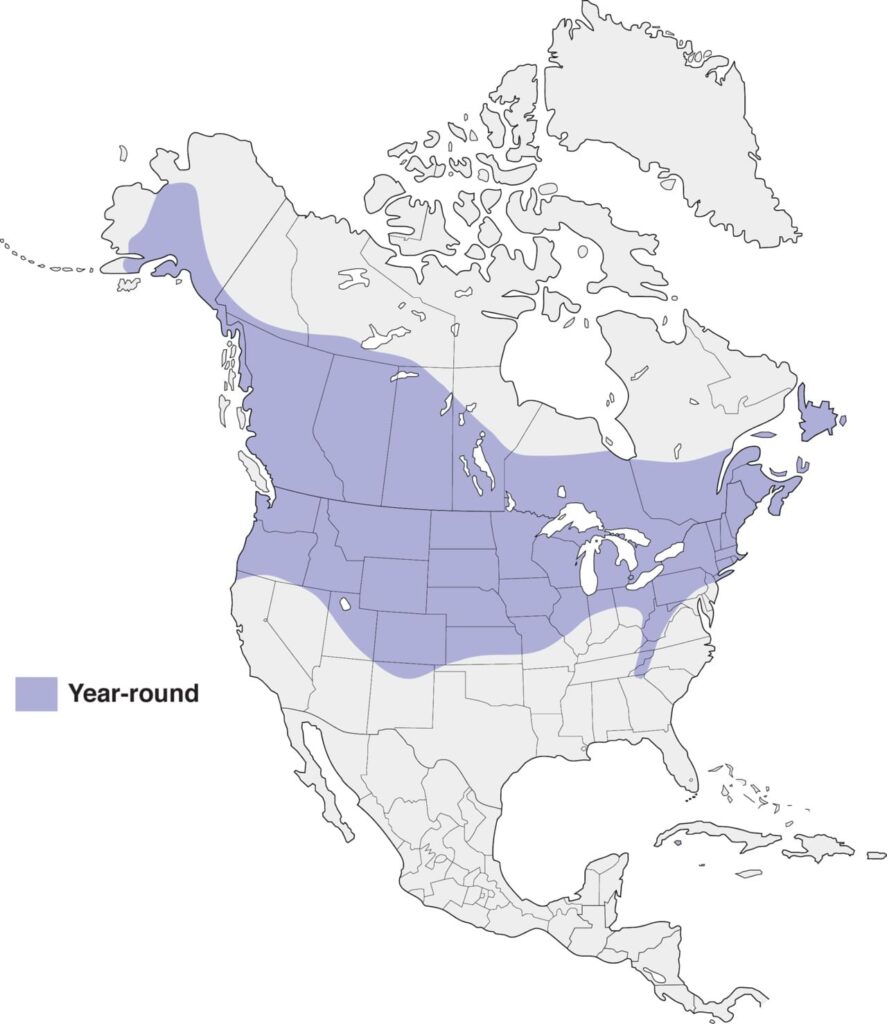
Range: Canada (Except Nunavut and Labrador). American Northwest, Midwest, and Northeast.
Etymology
Black-capped chickadees’ name comes from the distinctive black plumage on their head, which gives the appearance that these birds hare wearing a little black cap.
Chickadees broadly are named after one of their most recognizable calls, which sounds like, “chickadee-dee-dee.”
Fun Fact: This "chickadee" song is actually a warning call. The more "-dee" notes sung, the greater the threat level.
In French these birds are known as Mésange à tête noire (meaning black-headed chickadee/tit) and in Spanish they are called Carbonero Cabecinegro (meaning black-headed coal-tit).
Description
Black-capped chickadees are in the family Paridae, which includes chickadees, tits, and titmice. North American species in this family are known as chickadees, while their Eurasian and African counterparts are called tits/titmice.
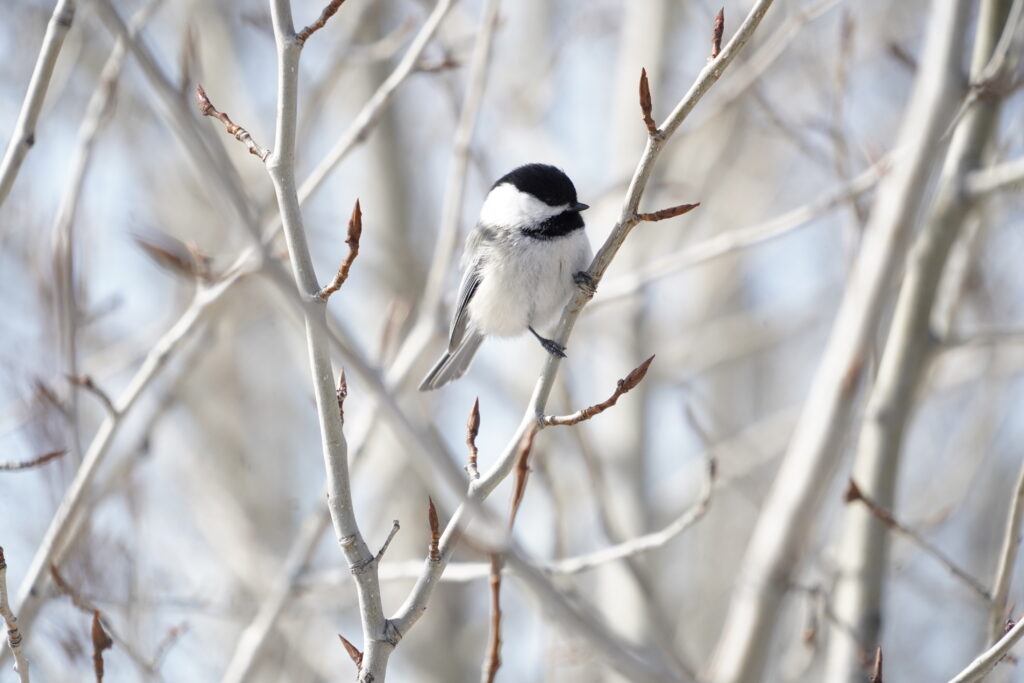
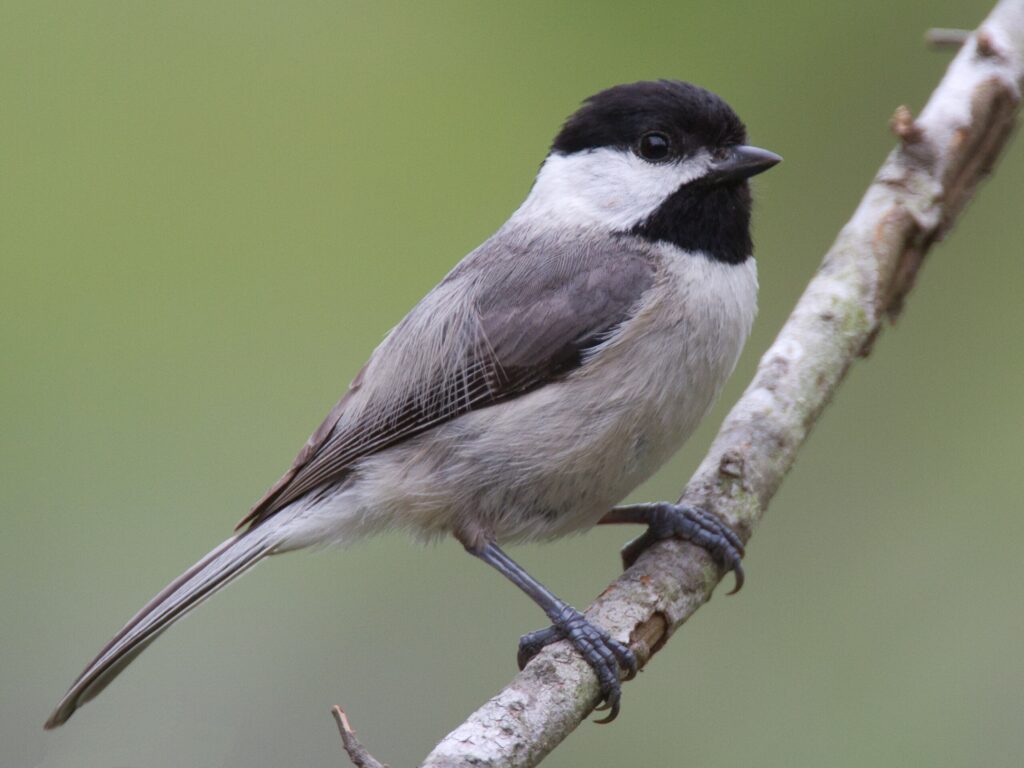
These beloved backyard birds can be identified by their black ‘cap and bib’, grey back, whitish belly; and buff-coloured sides. There is little difference between males and females. Chickadees are about the size of a sparrow, with a wingspan between 15 and 20 centimetres; and weighing between 9 and 14 grams.
Black-capped Chickadees look most similar to Carolina Chickadee (P. carolinensis). The two species are discerned mainly by range, though the two species hybridize in a narrow zone of the eastern United States. Lesley the Bird Nerd made a great video on how to tell the two species apart.
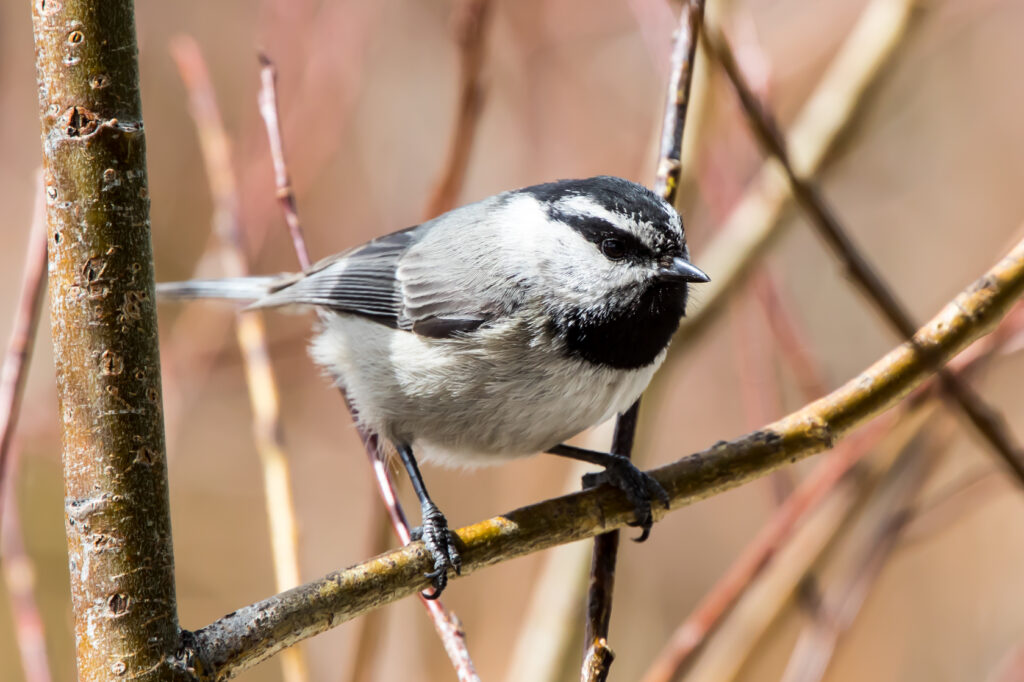
Genetically, the Black-capped Chickadee’s closest relative is the Mountain Chickadee (P. gambeli), which has a distinguishing white eyebrow.
Habitat
These chickadees are found in deciduous and mixed forests, open woods, willow thickets, and cottonwood groves. These adaptable birds can live pretty much anywhere with trees, and are often found in human-modified habitats, including orchards, parks and urban areas.
Chickadees are not considered migratory. However, large groups of chickadees — usually juveniles — fly southward. These “irruptions” are generally not considered true migration, and rarely extend past the Chickadees typical range.
Nesting
Black-capped Chickadees nest in nest boxes and small cavities, and are typically found between 1.5 and 8 m high. Chickadees are known to use abandoned downy woodpecker cavities, or excavate their own cavities. Cavities are then filled with wood shavings, animal hair, feathers and moss.
Diet
Diet: Insectivorous
Chickadees are primarily insectivorous, with some plant matter. The proportion of insect to plant matter varies depending on season (detailed below).
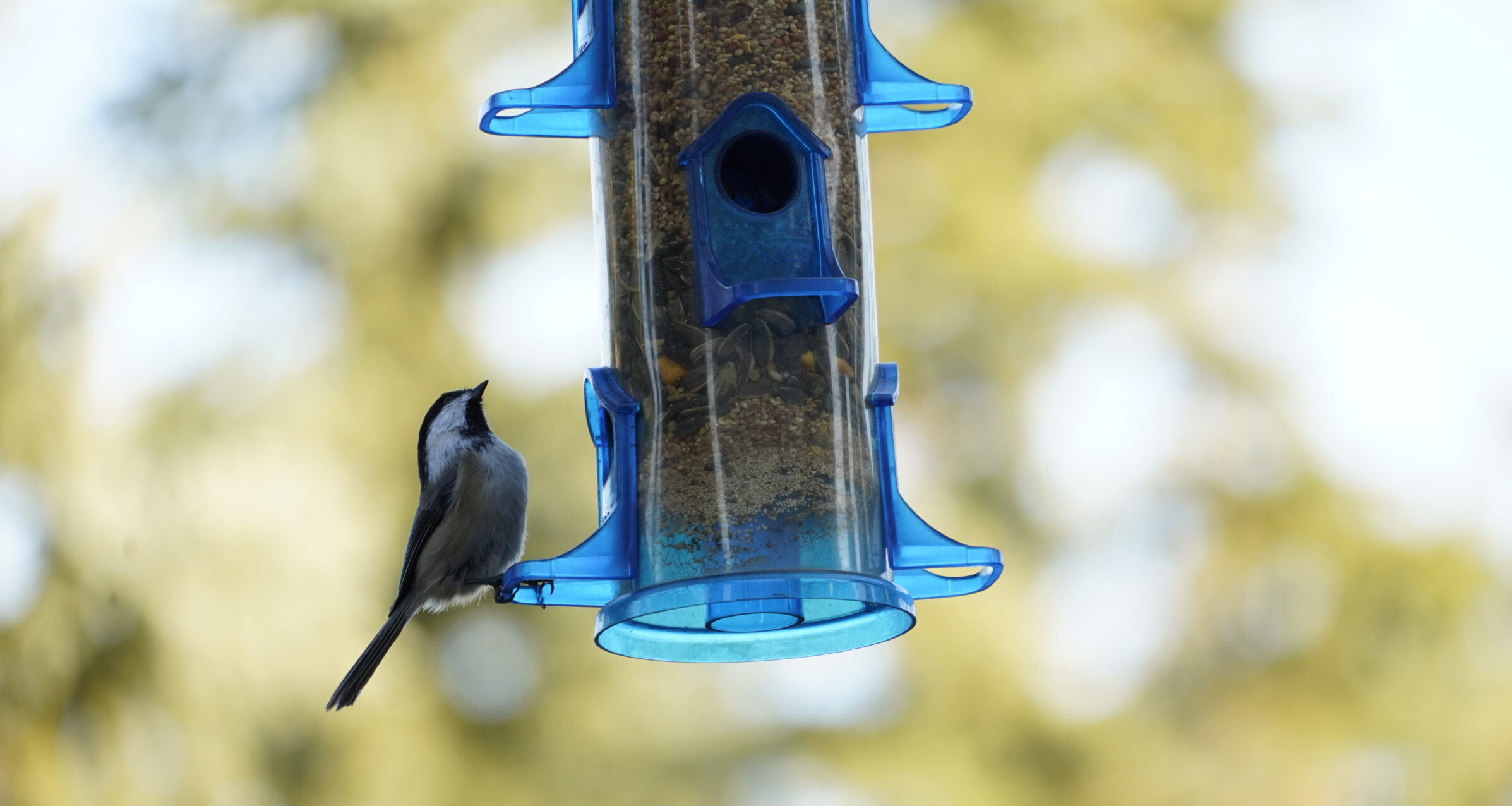
If you are looking to attract chickadees to your feeders, they prefer sunflower seeds, peanut butter, peanuts, suet, and mealworms.
Winter Diet
During the winter, about half of a chickadees diet comes from plant matter, and half from animal sources.
Plant sources: Seeds, berries.
Animal sources: Insects, spiders, suet, occasionally carrion.
Summer Diet
Insects and other arthropods comprise between 80-90 per cent of a Black-capped Chickadee’s diet during the breeding season. They eat larges quantities of insect eggs, larvae, and pupae.
Plant sources: Seeds, berries
Animal sources: Weevils, lice, sawflies, and spiders.
Interspecific Interactions
Predators
Chickadees have to be on the look out for hawks and Northern Shrike which are their primary predators.
Owls, snakes, raccoons, weasels, chipmunks, opossums, mice, and squirrels are also known predators. Predators may find, enter and raid nests. Eggs and young birds are eaten, and adult females are sometimes killed on their nests.
Behaviour
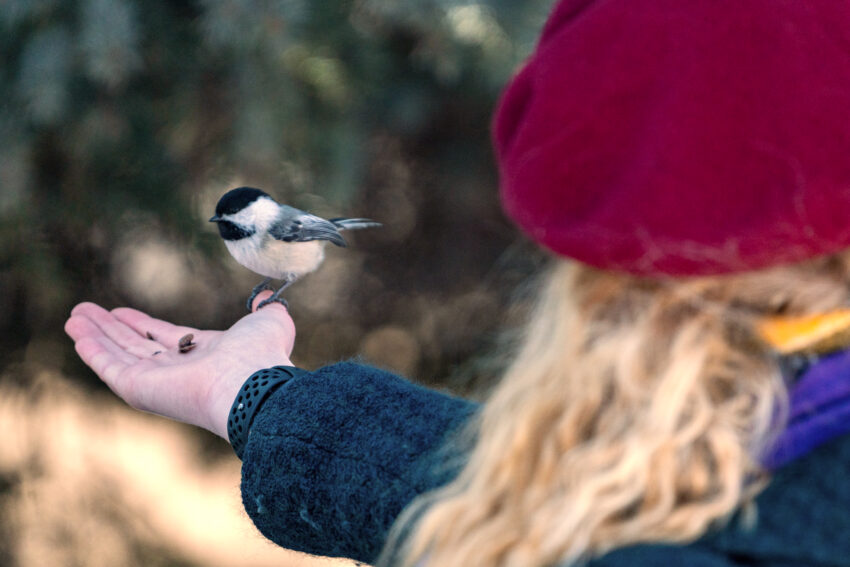
Chickadees are active, curious, and social birds. They are known to be very curious towards people and are often willing to land on an outstretched hand — a delightful experience every time.
Social order is determined by aggressiveness. Each bird is know to others in its flock by rank, with the most aggressive chickadees asserting dominance over the others. Chickadees assert themselves vocally and physically. During breeding season song contests between males can escalate to the point that two males, feet-locked, plummet to the ground together.
As a rule, males dominate over females, and adults dominate over juveniles. Higher social rank within a flock grants the individual better access to food and nesting sites, as well higher survival rates for offspring.
Black-capped chickadees socialize with more than just themselves. Various birds will flock amongst chickadees, including woodpeckers, nuthatches and warblers. Black-capped chickadees associate so closely with other species that several species will respond to their warning calls.
Complex Communication
On the topic of their calls, chickadees have highly advance communication. With songs so complex they resemble language, chickadees are able to communicate information on the identity of other flocks, in addition to producing predator alarms and contact calls.
Food Caches
As the weather cools, black-capped chickadees start to hide seeds and other food items for the winter. Each item is placed in a different spot or cache. To remember thousands of caches, these fluffy friends have developed a brilliant adaptation!
Every autumn, old neurons in the chickadee’s brains die, effectively deleting the old memories with them. These neurons are replaced, allowing chickadees adapt to changes and learn new things despite their small brains.
Reproduction
Mating System: Monogamous
Black-capped chickadees are monogamous, and usually mate fore life (though extra-pair copulations do occur). They mate once a year, with breeding season lasting from April to early August.
Chickadees lay between one and 13 eggs, which are white with little reddish-brown spots. Eggs are incubated for 12-13 days before hatching. Chickadees are born with their eyes closed and are mostly featherless, but they grow up quickly. After about two weeks chicks are ready to leave the nest and learn to fly. By the time the chicks are six weeks old, they are largely independent.
Niches
Ecosystem Roles
Black-capped chickadees serve as one of nature’s exterminators. They eat large quantities of insects, along with their eggs, larvae and pupae — making them vital for healthy forests.
Economic Importance
Because Black-capped Chickadees eat so many insects, they are an important form of pest control for orchards, helping to reduce reliance on pesticides.
Conservation
Threats
There are an estimated 43-million black-capped chickadees in the wild today, and the IUCN classifies the species as Least Concern in terms of conservation. Though like many North American species, chickadees populations are in slight decline.
Clearing forests for agriculture can increase the amount of forest edge — providing improved habitat for chickadees. However, since chickadees nest in tree cavities, they suffer when too much standing deadwood is cleared.
“Black-capped Chickadee.” (N.D.). Cornell University — All About Birds. Accessed via https://www.allaboutbirds.org/guide/Black-capped_Chickadee/overview
Foote, J. R., D. J. Mennill, L. M. Ratcliffe, and S. M. Smith. (2020). “Black-capped Chickadee — Poecile atricapillus.” Birds of the World. Accessed via https://birdsoftheworld.org/bow/species/bkcchi/cur/introduction
Rutherford, C.A., Richardson, L., Panjabi, A., Martin, R. (2025). “Black-capped Chickadee Peocile Atricapillus Species Factsheet.” Birdlife International DataZone. Accessed via https://datazone.birdlife.org/species/factsheet/black-capped-chickadee-poecile-atricapillus
“Black-capped Chickadee.” (2003). Hinterland Who’s Who. Accessed via https://www.hww.ca/wildlife/birds/black-capped-chickadee/
BirdLife International. (2025). “Poecile atricapillus (Black-capped Chickadee).” The IUCN Red List of Threatened Species 2025. Accessed via https://www.iucnredlist.org/species/22711716/137666504
Roof, J. (2011). “Parus atricapillus (black-capped chickadee).” Animal Diversity Web. Accessed via https://animaldiversity.org/accounts/Parus_atricapillus/
Otter, K. (2007). “The Ecology and Behaviour of Chickadees and Titmice.” Oxford University Press. Accessed via https://web2.uwindsor.ca/courses/biology/dmennill/pubs/2007Otter131.pdf
Read More

Backyard Friends: Black-capped Chickadee
The Backyard Friends is a series about animal pals that you might find in your backyard. No matter where we

New Year Update!
We have started the new year, so I thought it would be a good time to give a little update

Endorheic Lakes: The lakes that go nowhere
Most lakes go somewhere… Into a river, another lake, the ocean, something. However, some lakes feed no river, pour into