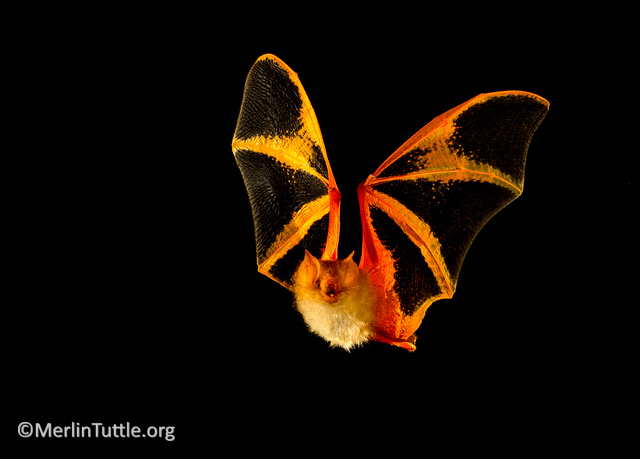
The Red List Friends is a series showcasing some of the world’s at-risk species from the IUCN’s Red List of Threatened Species. Today’s RedList friend is the Painted Woolly Bat.
Kerivoula picta is the scientific name for the painted woolly bat, also known as the painted bat, “butterfly bat”, “coloured bat”, or “orange brown bat”. This bat species is famous for its bright orange coloration — making it a strikingly beautiful species. However, its beauty puts this species at risk, since it is often hunted for ornamental trade and collecting.
My latest video is all about the Painted Bat: its biology, ecology, threats and how we can help protect this at-risk species.
Tamowsky, B. (2024). “Exploring Thailand, Part 1: Beauty Among Banana Leaves.” Merlin Tuttle Bat Conservation. Accessed via https://www.merlintuttle.org/exploring-thailand-part-1-beauty-among-banana-leaves/
“Kerivoula picta.” (N.D.). Bat Conservation International. Accessed via https://www.batcon.org/bat/kerivoula-picta/
“Painted bat (kerivoula picta).” (N.D.). Thai National Parks. Accessed via https://www.thainationalparks.com/species/kerivoula-picta
Funakoshi, K., et al. (2015). “Ecology and monogamous system of the painted wooly bat Kerivoula picta in Khon Kaen, Thailand.” Mammal Society of Japan. Accessed via https://bioone.org/journals/mammal-study/volume-40/issue-4/041.040.0402/Ecology-and-Monogamous-System-of-the-Painted-Woolly-Bat-iKerivoula/10.3106/041.040.0402.short
“Kerivoula picta (Pallas, 1767).” (N.D.). Global Biodiversity Information Facility. Accessed via https://www.gbif.org/pt/species/2432543#:~:text=fonte:%20Vespertilionidae-,breeding,likely%20live%20longer%20than%20this.
Balanger, L. (1999). “Kerivoula picta (painted bat).” Animal Diversity Web. Accessed via https://animaldiversity.org/accounts/Kerivoula_picta/
Birkett, K.; K. Weidman and Y. Woo. (2014). “Vespertilionidae (evening bats and vesper bats). Animal Diversity Web. Accessed via https://animaldiversity.org/accounts/Vespertilionidae/
“Painted Bat – Facts, Diet, Habitat & Pictures.” (N.D.). Animalia. Accessed via https://animalia.bio/painted-bat?taxonomy=95#google_vignette
Coleman, J., et al. (2024). “Dying for décor: quantifying the online, ornamental trade in a distinctive bat species, Kerivoula picta.” European Journal of Wildlife Research. Accessed via https://link.springer.com/epdf/10.1007/s10344-024-01829-9?sharing_token=cNU6zybVVsuQxIwziH5Jyve4RwlQNchNByi7wbcMAY7cnp7qWoigBPQFtBoRlzGUpcs47cEQyzWoeFH9HXebmytA8CkYiw1I-eM3Tbh52N5VQecvlpfYWfbrP8aXWYdTqc1dXWgXRI5cIF-KOwtPVmx8kf2LmBW2-Z3q8B1QAkQ%3D
“This Bat is Not for Sale.” (2025). Bat Conservation International. Accessed via https://www.batcon.org/this-bat-is-not-for-sale/
Read More

Is the Bat Trade Sustainable?
It’s easy to find bat and other exotic animal specimens, especially with the rise of social media and online marketplaces.

Red List Friends: The Painted Woolly Bat
The Red List Friends is a series showcasing some of the world’s at-risk species from the IUCN’s Red List of

10 Major Threats to Bats Worldwide
Bats play important roles in our ecosystems and economies, but they also face a variety of threats — many of