The Yellow Bird
Menu
  • home
  • posts
  • portfolio
  • Resume
Menu

The Death of the Prairies

Posted on November 17, 2025November 8, 2025 by Taylor Holmes

How the North American prairies went from one of the most productive to one of the most endangered ecosystems on the continent.

This republished article is part of a collaboration. To view all associated articles and media, click here.

Travis Jimmy John and Ronine Ryder in traditional Nakoda dress. Together the couple run the cultural and ecotourism company Nakota Îtipi & Ryder Style Craft. Photo Courtesy of Travis Jimmy John

In order to understand how the prairies became the most endangered ecosystem on the North American Continent, it is important to know what the prairies once were.

Travis Jimmy John is a Nakoda song-keeper who was raised on Eden Valley First Nation in the Foothills of the Rocky Mountains. Jimmy John would spend his days riding horses with other children, and was taught traditional knowledge from his elders like how to hunt and find water.

Unfortunately, even in his own lifetime, Jimmy John has seen a loss of the rich variety of life that once filled the lands he called home. This can be seen in the country as well. There are fewer animals overall and a noticeably fewer species. 

“You used to see porcupines everywhere out here growing up. Even had to be careful not to step on [them]. So numerous, they were at one point,” explains Jimmy John.

Before Colonization

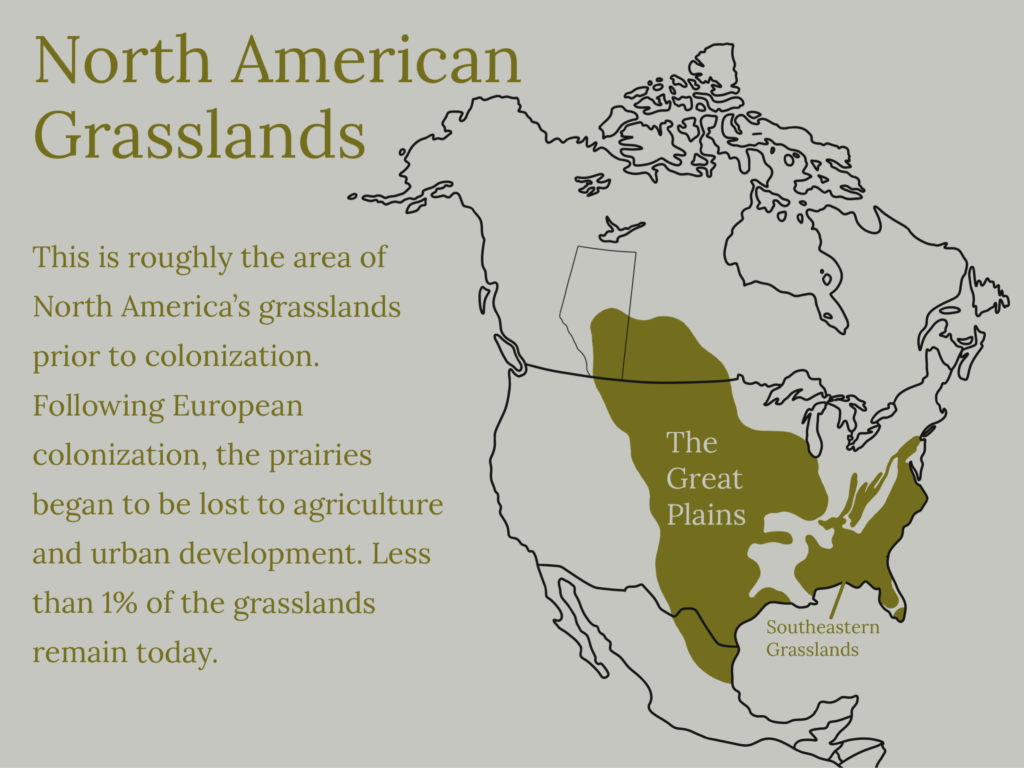
CREDIT: Taylor Holmes

Prior to European colonization, prairies and grasslands covered much of the continent. From Alberta to Manitoba, and Texas to Alabama, a range of grassland habitats once covered the expanse of the continent. While the climate across the prairies varies – and thus the species that inhabit them – all prairies all consist primarily of grasses, small shrubs and sparse trees. 

“My grandmother said to me… you could camp somewhere and you could hear a buffalo herd moving, shifting around. You can hear them when they go across the land. They go around and it shakes. Life was teeming during the day and the night. So it was not empty, it was full of life,” says Jimmy John.

These rolling prairies provided several Indigenous cultures with ample resources in the form of plants and animals. Additionally, Indigenous people across the prairies routinely helped renew the prairies through prescribed fire – controlled, slow-burning grass fires lit during colder and wetter months. Prescribed fire reduces the risk of massive, scorching grass fires during the dry season, and improves the variety of life in the burned area.

Kyle Lybarger is a forester and conservationist from Alabama. Lybarger runs a TikTok account with over 400,000 followers (@nativeplanttok) where he shares his knowledge and passion of the grasslands with others. Lybarger is an advocate for responsible grassland management and prescribed fire, and he notes that this practice was first done in North America done by Indigenous peoples.

“I try to always pay dues to the Native Americans using this fire…. They saw that wildlife numbers improved in these burnt areas. They were game rich, they were gonna have more rabbits, quail, turkeys, more game species for them to hunt,” Lybarger explains, “But also it improved plant diversity.”

In Alberta, Jimmy John explains that it was primarily the Blackfoot people who used prescribed fire to attract buffalo and all that followed, but all of Alberta’s First Nations worked to keep the environment in balance and take from the land modestly. 

Indigenous North Americans stewarded the environment and enabled the prairies to thrive through responsible use and management, but they did not do it alone.

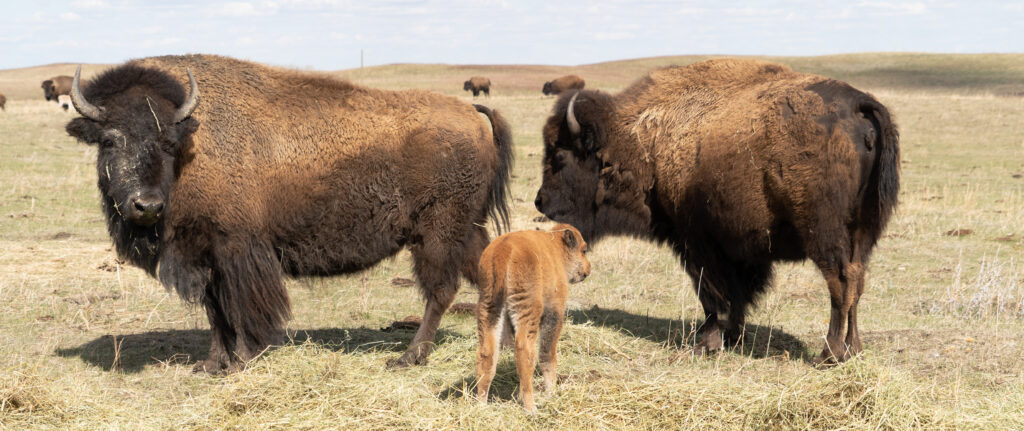
Two adult bison and a calf on a ranch near Longview, Alta. PHOTO CREDIT: Taylor Holmes

The Bison and the Beaver

The American bison is considered a keystone species to the prairie ecosystem – meaning that the bison’s role is vital in maintaining a healthy prairie and it impacts all the species in the ecosystem. 

Bison wallowing, a behaviour which creates barren patches in the dirt, allowed new species to establish themselves. Their manure fertilized that same earth. Seeds would be carried in the bison’s fur, transplanting plant species throughout the ecosystem.

The buffalo were also a vital resource for Indigenous peoples across the prairies. Grant MacEwan’s book, Tatanga Mani: Walking Buffalo of the Stonies(1969), details just some of the uses for buffalo carcasses furnished fresh meat as well as the principle ingredient for making pemmican for storage; buffalo bone marrow was a good food for babies at weaning time; skins could be made into clothing; buffalo hides sewn together with sinew made a durable tipi covering; the horns were used in making utensils.

“The reason the buffalo was so relied upon was the buffalo was a walking ecosystem where the buffalo went, the birds followed and whatever prayed on the birds, followed the birds and whatever prayed on them, followed and so and so on,” Jimmy John explains, “Buffalo will never drink stagnant water. They’ll always drink fresh water. So they knew where all the springs were in the prairies and out in the foothills here. So by observing the buffalo and being close with them, this is how we knew how to survive. The buffalo taught us this.”

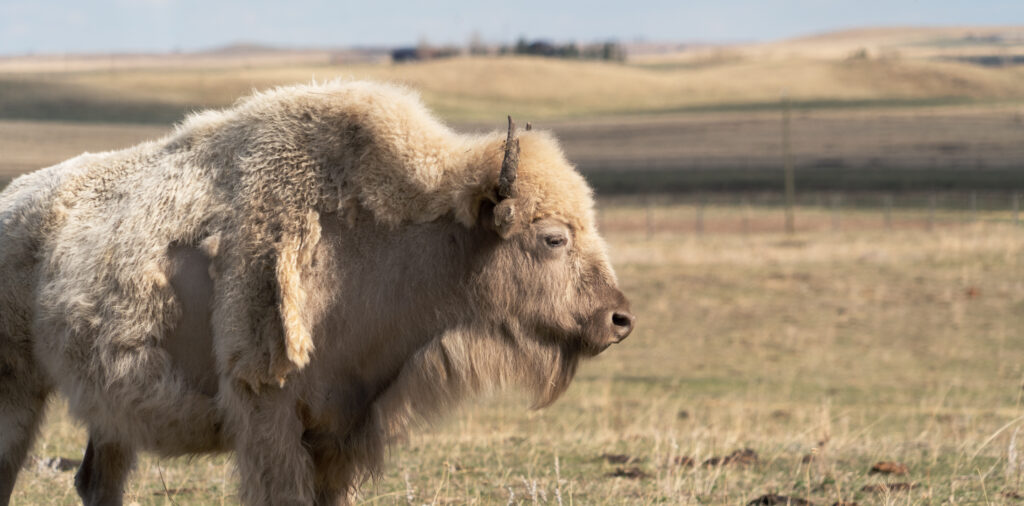
A white bison near Longview, Alta. Within Nakoda tradition, the white bison holds particular cultural and spiritual significance. PHOTO CREDIT: Taylor Holmes

Another vital species for the grasslands are the beaver. Beavers are known as ecosystem engineers due to the way they shape the environment. Removal of trees for dams helps prevent grasslands from becoming forest, and the dams beavers build help increase biodiversity and improve water quality.

The bison and the beaver were vital elements of the North American prairie ecosystem, but now the bison is functionally extinct. A fate narrowly escaped by the beaver. 

So, what happened?​

The Impact of Colonization

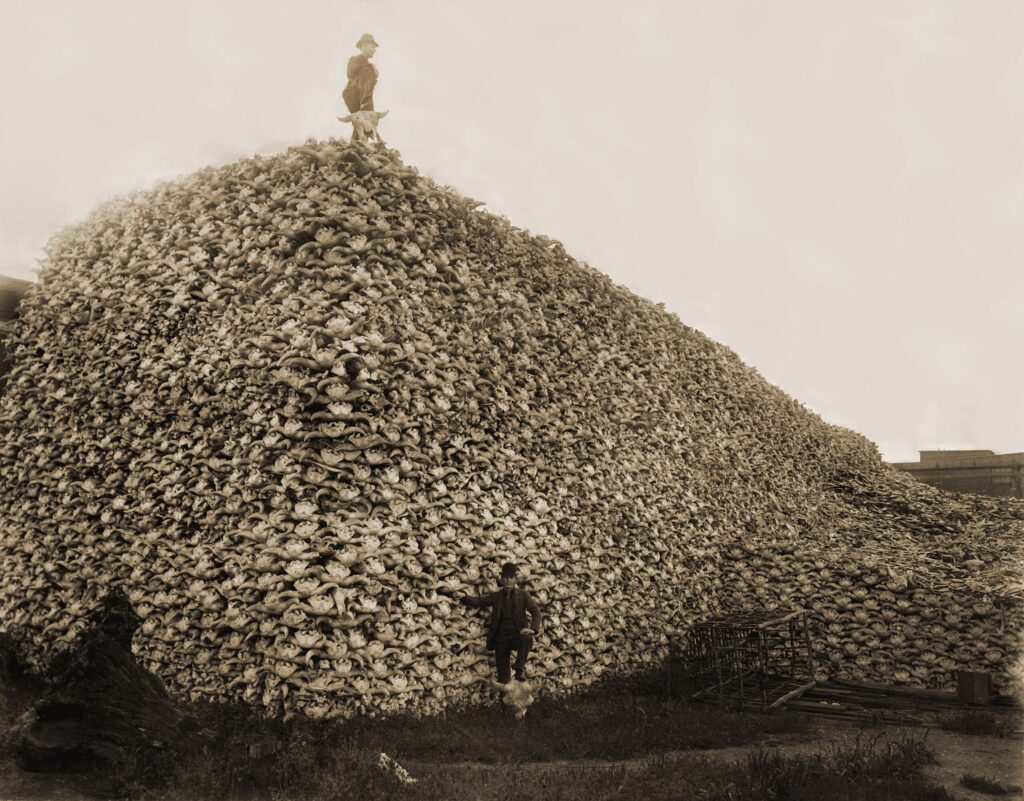
There were once an estimated 30 million bison across North America, but now most people who live in their historic range have never seen a bison in person. Colonization of Canada and the United States drove the declines of bison. 

In the United States during the late 1800s, it was official government policy to kill bison, the goal to starve Indigenous people into submission and force them onto reservations. One American colonel is quoted as saying, “Kill every buffalo you can! Every buffalo dead is an Indian gone.”

“The buffalo gave sovereignty to everybody, we’re a sovereign nation. This is why we have treaties with the Crown. You don’t make treaties with conquered people. That’s what I had to point that out. We were a sovereign people and the buffalo helped us to achieve that,” says Jimmy John.

Stacks of American bison skulls waiting to be ground into fertilizer in the United States, circa 1892. PHOTO CREDIT: Burton Historical Collection, Detroit Public Library
In Canada, official policy wasn’t as blatant, however the signing of the treaties had ramifications that would devastate the prairies as well as its people. Land was taken and converted to farmland for crops and cattle, and the bison were now seen as a pest. Additionally, development of the railways fragmented habitats and herds and made it harder for the species to survive.

“The year following Treaty Number Seven brought extremely heavy slaughter of buffaloes, and the Canadian tribesman also suffered. It was difficult to believe: tens of millions buffaloes in 1877 yet virtual extermination of the herds a mere five years later. Only white bones, not quite hidden by the long prairie grass, remained as evidence of the original numbers,"

Grant MacEwan, p. 77 Tweet
In contrast to Indigenous hunting where animals were hunted only until one’s needs were met, and every component of the animal was used, settlers killed the bison en masse for sport.
“Back then [pre-European contact], we didn’t have all this [material things] but we still thrived. Because of the buffalo, the government knew this, what they did was intentional,” says Jimmy John.
 
“They slaughtered the buffalo. They didn’t even eat them. They just slaughtered them. From what I heard they used them for sport down in the US. Some of them [hunters] would be riding on the trains, driving by and shooting them, leaving them there to rot. To us that was a big no-no.”
 

For the beavers, the fur trade would be the cause of their demise. Starting in the 1600s, the fur trade was built upon European demand for furs to make hats. Within a matter of a couple of centuries, demand for fur outgrew supply and beavers were hunted nearly extinct in North America.

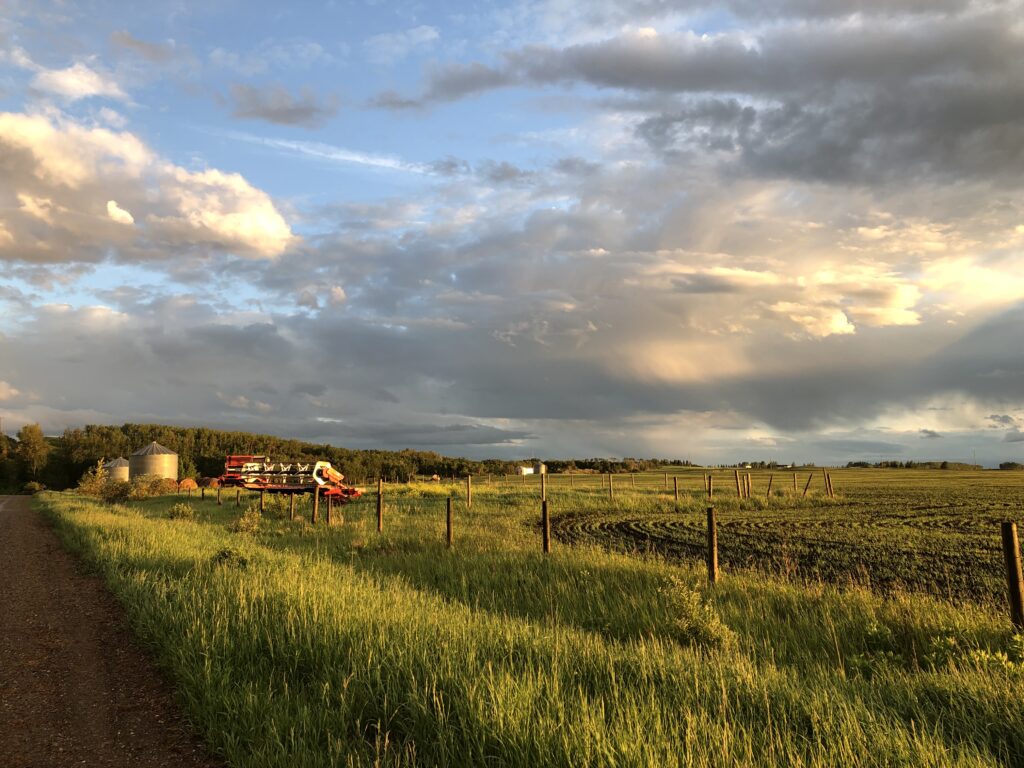
Most modern farms use intensive techniques that can deplete soil and damage the environment, such as excess fertilizers, pesticides, and use of monocultures. PHOTO CREDIT: Taylor Holmes

Another impact of colonization would be the introduction of European agricultural methods that began in the 1800s. The introduction of fossil fuels and development of mechanization, synthetic fertilizers, chemical pesticides and irrigation techniques in agriculture during the nineteenth and twentieth centuries as European colonists settled in North America added further strain to the prairies. 

These new forms of industrial agriculture are energy and resource intensive, depleting and creating an imbalance in nutrients in the soil. Further, the use of monocultures – large swaths of only one crop – left the prairies less ecologically productive overall, since the diversity of plant and animal life that made the prairies thrive were pushed out in place of canola and wheat fields.

The Suburban Dream

Lawn is the largest irrigated crop in the United States, and has replaced productive prairie with a habitat that doesn't support much life. PHOTO CREDIT: ArtisticOperations

Another contributor to the loss of prairie habitats across the continent lies right underneath many of our noses. In most communities across the prairies the plants in people’s yards are not native prairie species, nor do the yards boast the diversity the prairies once held. Instead, manicured monocultures and an array of introduced species are the standard in North America.

“All the best grasslands I’ve been to have cogongrass [and invasive lawn grass]popping up all over the place, the only way you could get rid of it was to spray them with herbicides several times over a couple of years,” says Lybarger, “[and] that plant is still being sold in Home Depot. You can go to [garden centres] and still buy cogongrass”

The modern, North American concept of the suburb took hold following the Second World War. With the war over and cars becoming more common people could now afford to live further from their work and other necessities, this allowed for an expansion of the urban landscape with sprawling single-family homes with green lawns and picket fences which replaced the once expansive prairies. 

Unfortunately this suburban dream of a green lawn without a weed in sight is the opposite of a productive, healthy ecosystem. Instead of rich biodiversity and an array of wildflowers, grasses and shrubs, the prairies have been replaced with lawns that require maintenance that damages the ecosystem long-term, like over-dependence on fertilizers, pesticides, and excess watering which create chemical imbalances or toxicity in the environment.

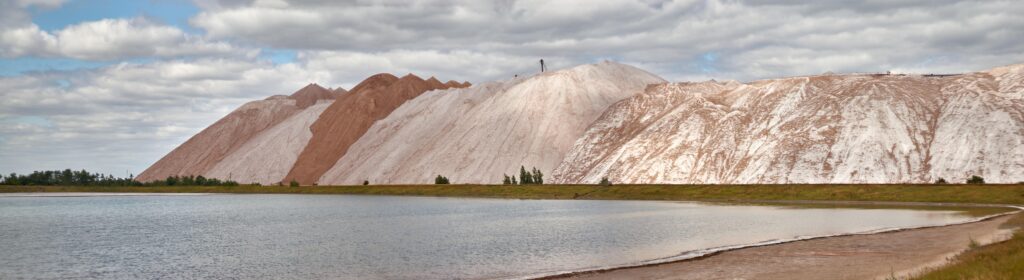
A pile of potash. Potash, which is high in potassium, is used extensively in the production of synthetic fertilizers for lawns and agriculture. PHOTO CREDIT: CatKosianok

Furthermore, this homogenous environment is the perfect breeding ground for pests to proliferate. Because of the lack of diversity, the organisms that would usually help keep insect, arachnid, mammalian and plant pests in balance are not able to live. The result of this is that pests come in to fill the gaps left in the monotony.

Where are we Now?

Practices dating back to the 1600s have contributed to the decline of North America’s grasslands, but the true extent of the damage is only beginning to be understood.

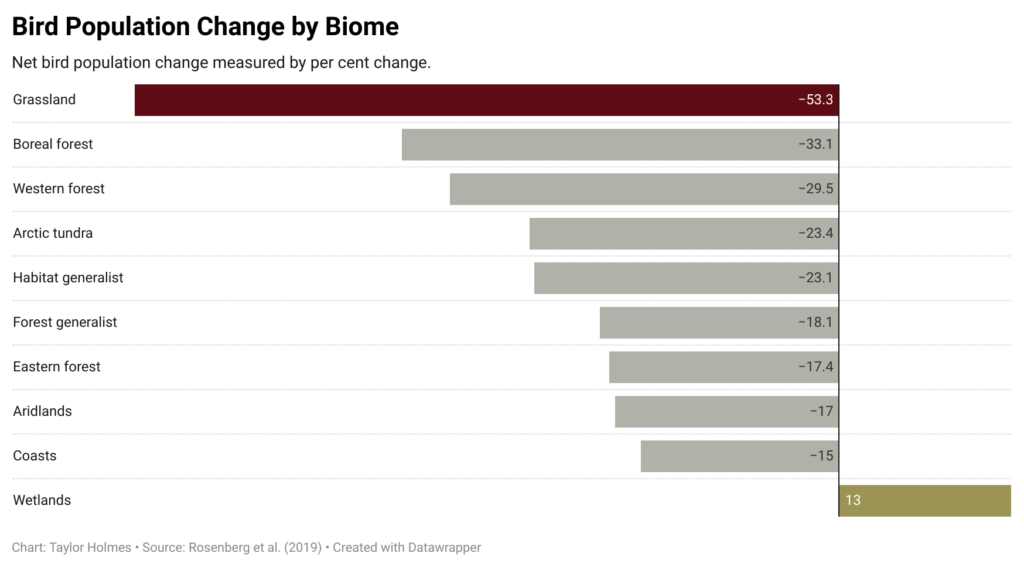
Ken Rosenberg, PhD, is a retired conservation biologist with the Cornell Lab of Ornithology. In 2019 Ken Rosenberg and colleagues published the Decline of the North American Avifauna, which found that North America has lost a net equivalent of 2.9 billion birds since 1970 – and grassland species saw the largest declines by habitat. This is significant not only for bird populations, but also for the ecosystem as a whole.

“What we found that was a surprise is this giant net loss in abundance across all species,” Rosenberg explains, “Some of the most abundant birds that are very common, sort of generalist species like grackles and robins, those sorts of things were also declining.”

While some species, notably waterfowl and birds of prey, saw increases in population — it’s not enough to counteract the overall decline. Birds play a vital role in grassland ecosystems including dispersing seeds, managing pests, and sanitation services, and these massive declines impair this ability for the environment to manage itself. 

Furthermore, these declines act as a canary in the prairies. Birds are one of the easiest groups of animals to observe and record, and humans have been doing so reliably for decades — whereas other groups (mammals, amphibians, insects, plants) are much harder to count and monitor. The fact that avian declines are so expansive, and that even generalist and introduced species are declining, speaks to an ecosystem that is unhealthy. 

“Those broad ecosystems are unhealthy…. When we saw these massive declines in those species which are thought of as pests, and those are declining at the same or higher rate even than of the native species, that’s what really brought home this idea that it’s the underlying health of the environment,” says Rosenberg.

The declines being seen in birds across the continent and prairies is likely just the beginning. Rosenberg and other conservationists believe that sharp declines are likely occurring in other groups of organisms, but these declines have simply not been documented yet – emphasizing the need to act now to slow declines and find balance between supporting our needs and protecting the prairies.
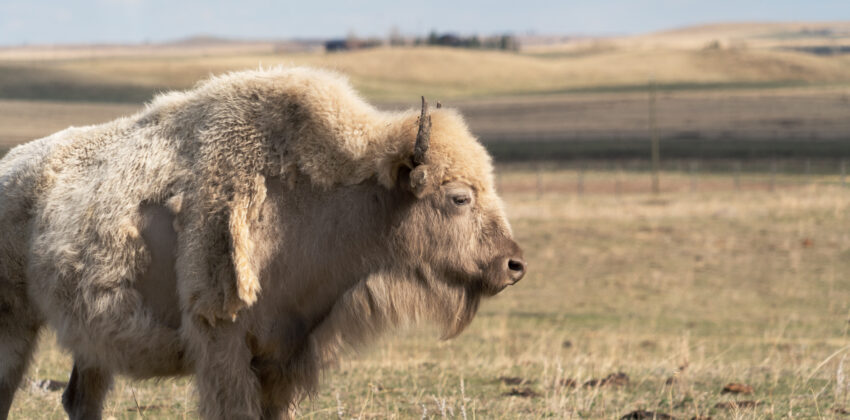
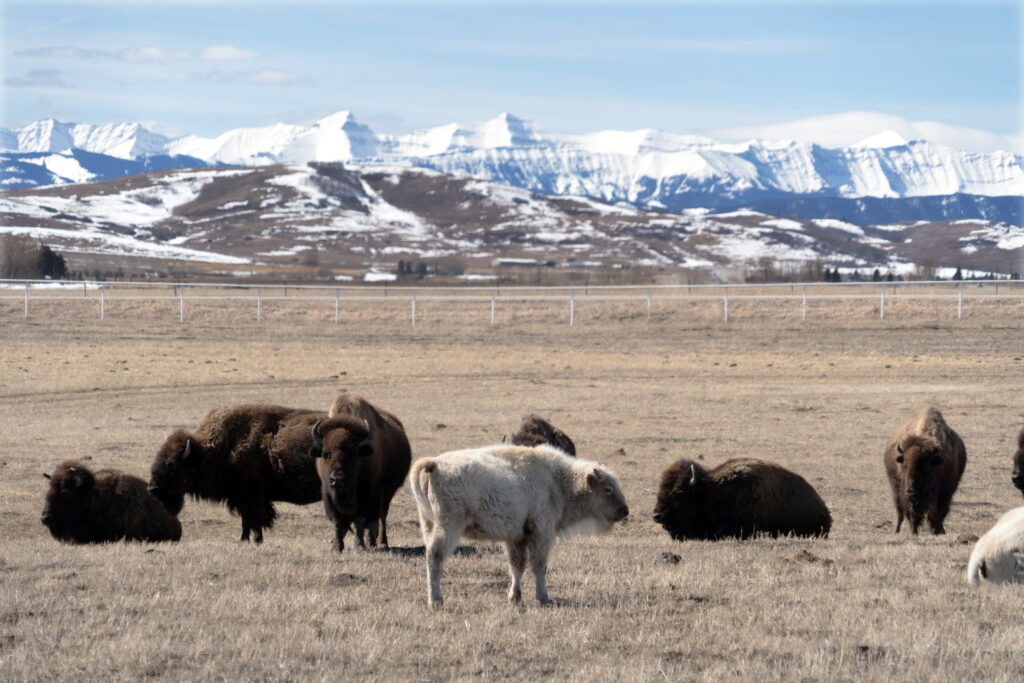
A herd of bison outside of Longview, Alta. PHOTO CREDIT: Taylor Holmes

Read More

Endorheic Lakes: The lakes that go nowhere

November 27, 2025 No Comments

Most lakes go somewhere… Into a river, another lake, the ocean, something. However, some lakes feed no river, pour into

Read More »

The Death of the Prairies

November 17, 2025 No Comments

How the North American prairies went from one of the most productive to one of the most endangered ecosystems on

Read More »

Is the Bat Trade Sustainable?

November 3, 2025 No Comments

It’s easy to find bat and other exotic animal specimens, especially with the rise of social media and online marketplaces.

Read More »

Share this:

  • Click to share on X (Opens in new window) X
  • Click to share on Facebook (Opens in new window) Facebook

Leave a Reply Cancel reply

Your email address will not be published. Required fields are marked *

  • November 27, 2025 by Taylor Holmes Endorheic Lakes: The lakes that go nowhere
  • November 17, 2025 by Taylor Holmes The Death of the Prairies
  • November 3, 2025 by Taylor Holmes Is the Bat Trade Sustainable?
  • October 31, 2025 by Taylor Holmes Red List Friends: The Painted Woolly Bat
  • October 29, 2025 by Taylor Holmes 10 Major Threats to Bats Worldwide
  • YouTube
  • Instagram
  • TikTok
  • Tumblr
  • LinkedIn
©2025 The Yellow Bird
 

Loading Comments...