The Backyard Friends is a series looking at animal pals that you might find in your backyard. This segment is about the only marsupial in the U.S. and Canada — the Virginia Opossum!
Table of Contents
Overview
Scientific name: Didelphis virginiana
Common name(s): Virginia opossum, opossum, ‘possum (also spelled possum), yapok (south).
Average Lifespan: 1.5-2.5 years (wild), 3-4 years (captivity).
Range: Belize; Canada (Ontario, Quebec); Costa Rica; El Salvador; Guatemala; Honduras; Mexico; Nicaragua; United States
Biogeographic Regions: Nearctic, neotropical
Conservation Status: Least Concern (Population Increasing).
Description
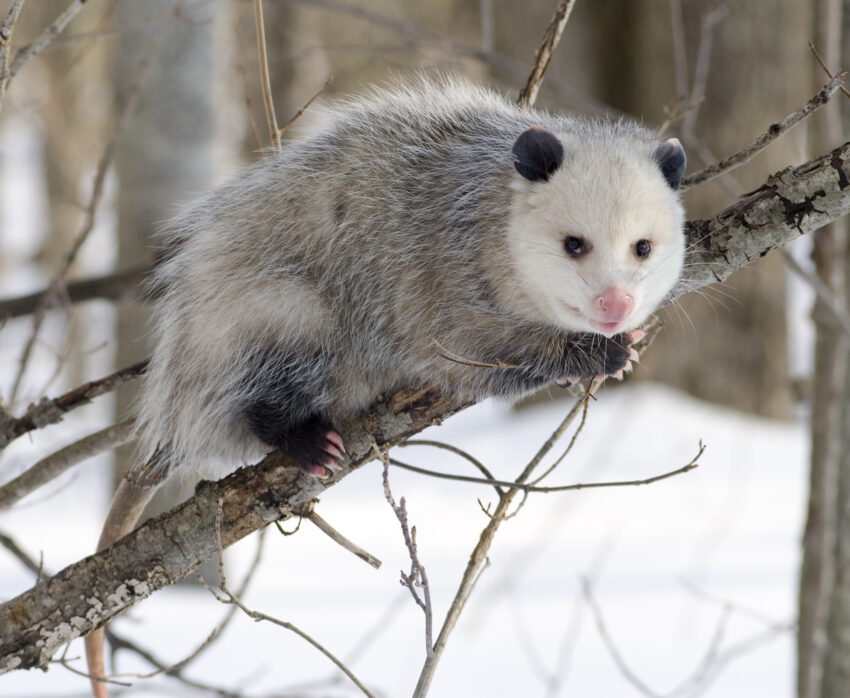
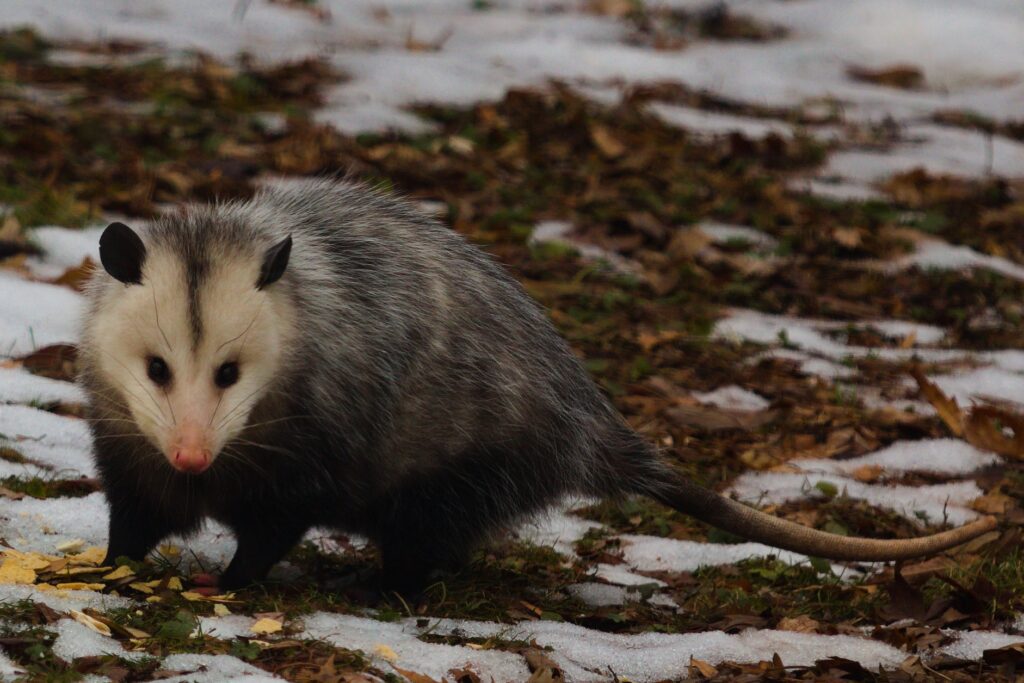
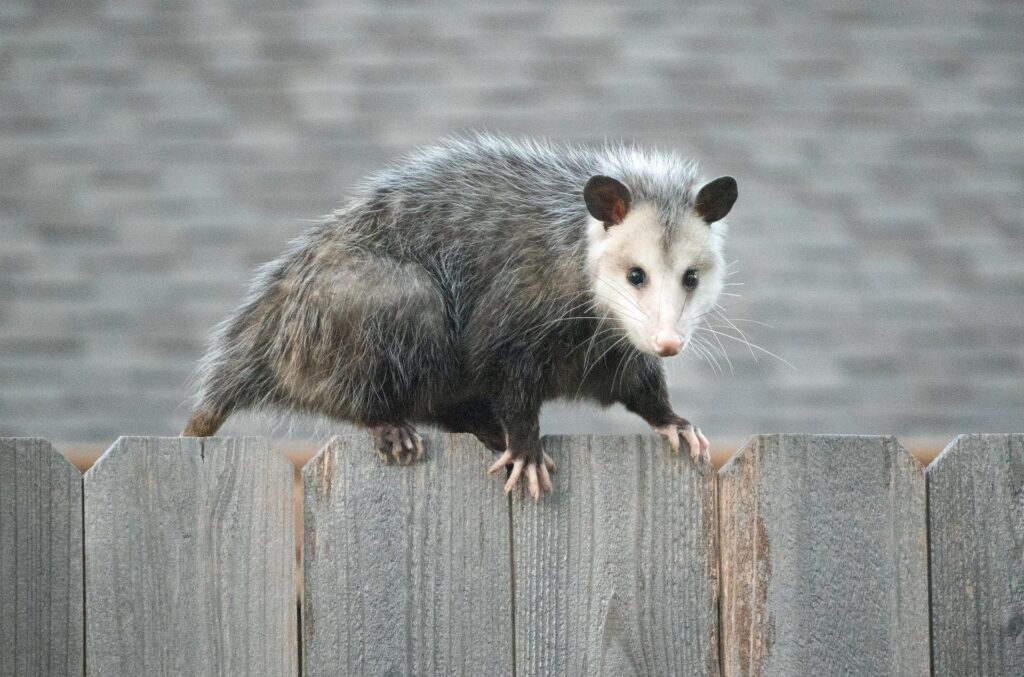
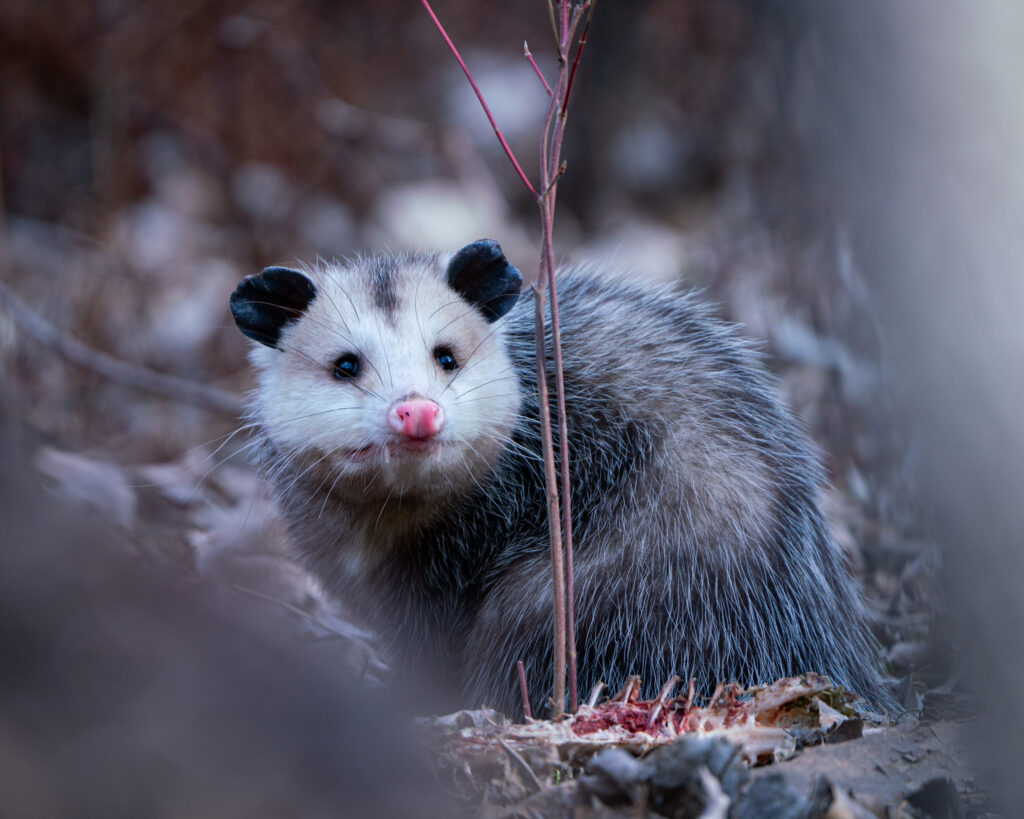
The Virginia Opossum is about the size of a house cat, weighing between 2-6 kilograms (4-13lbs) on average, and have short legs and thick bodies. Colouration varies between populations, but their fur is typically greyish, with lighter and longer guard hairs. Northern populations usually have lighter guard hairs and thicker under fur, while southern populations have darker, thinner fur. The fur around the opossum’s face tends to be lighter than the rest of their bodies.
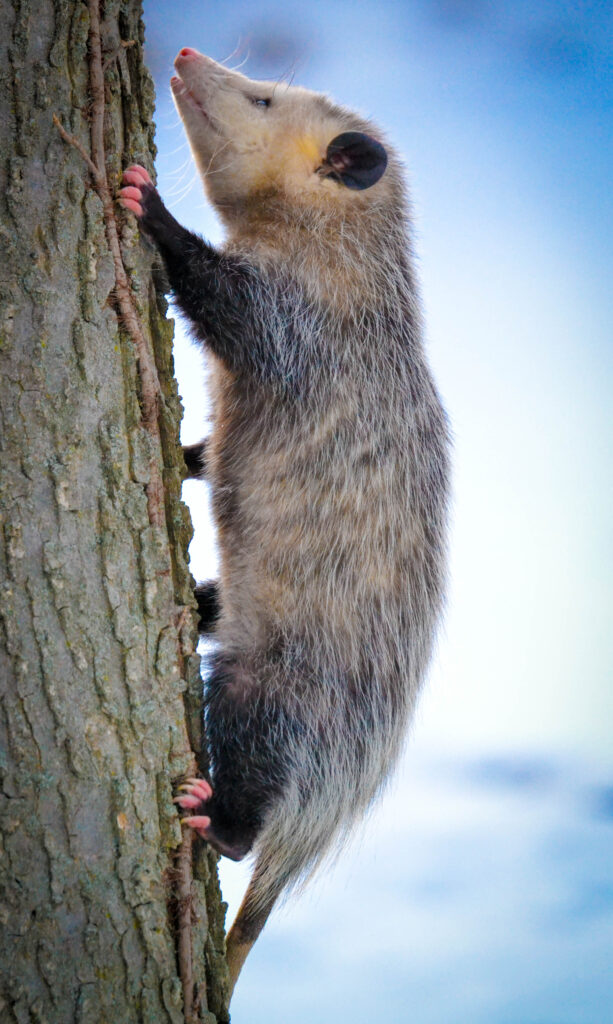
Opossums have thin, hairless, tails which are nearly long as their body. The opossum’s tail is prehensile, and is used when climbing as an additional limb.
Fun Fact: The Virginia opossum also has a total of 50 teeth — the most of any North American land mammal!
Taxonomy
The family Didelphia (American opossums), contains at least 172 species found across the Americas — most of which live in Central and South America. The Virginia opossum is the northernmost marsupial species (infraclass Marsupialia) on earth and the only marsupial found in Canada and the United States.
The vast majority of mammals, including humans, belong to the infraclass Placentalia (placental mammals), which diverged from Marsupials between 160-125 million years ago. This means that American opossums are more closely related to Australian wildlife like kangaroos, wallabies, koalas, wombats, bandicoots, and tasmanian devils than most of their mammalian neighbours in the Americas.
Etymology
The name Opossum comes from Powhatan, which was an Algonquin language formerly spoken in what is now eastern Virginia (Note: The Powhatan people still exist, but their language was largely lost due to colonization).
Apasum/apousoum was the Powhatan word for the Opossum, and means “white animal/dog.” Shortly after the word was first documented in English in 1610, people started to drop the “O” colloquially turning opossum into ‘possum — but both terms refer to the same animal.
Within their range, they are typically referred to as simply opossums or ‘possums — not be confused with possums from Australasia.
Habitat
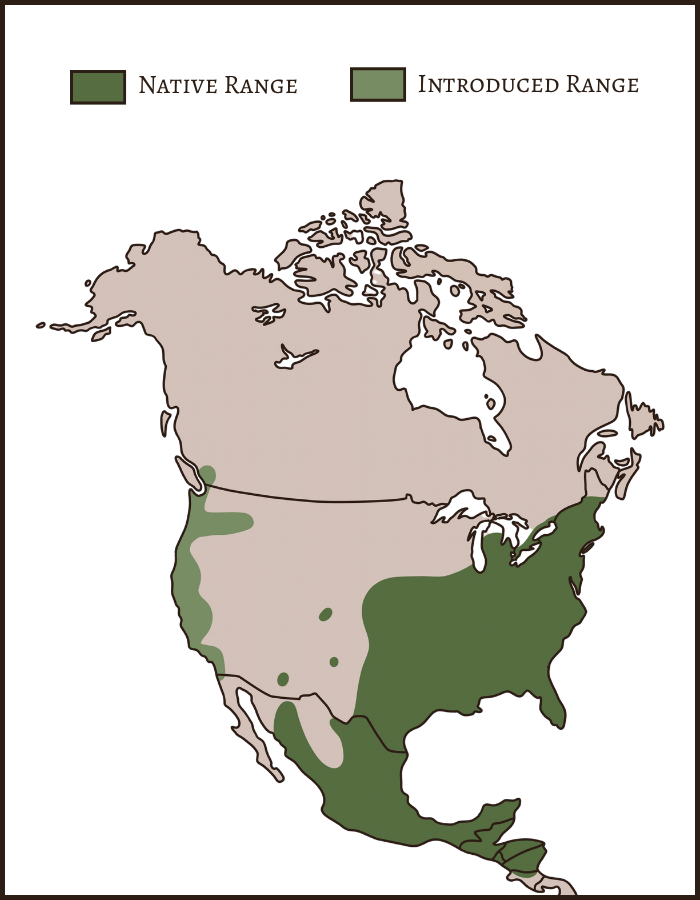
The Virginia Opossum has the northernmost range of any marsupial on earth, from southern Ontario and Quebec in Canada, through most of the eastern United States and Mexico, south to Costa Rica. Populations have also been introduced on the west coast, from California to southern British Columbia.
Habitats include temperate, subtropical, and tropical forests; temperate shrub lands; prairies; and marshes.
Opossums prefer to live in wet areas, especially woodlands and thickets near streams. However, they also utilize human-modified habitats, living alongside humans in both rural and urban areas alike, including farmlands, rural garden, towns, and cities.
Opossums build dens in abandoned animal burrows, hollow logs, tree cavities, rock piles, under porches, and sometimes inside buildings.
Diet
Diet: Omnivorous.
Opossums have a diverse diet, eating a mix of plant and animal matter, including carrion. This species is opportunistic, and will eat invertebrates such as insects and worms, small mammals, leafy matter from grasses and woody plants, and soft mast such as berries. Opossums are also known to eat carrion and forage through human trash looking for food.
Interspecific Interactions
Predators
Opossums are preyed on by owls, bobcats, coyotes, raccoons, snakes, red foxes and domestic dogs — and they’ve developed several unique adaptations to avoid being eaten.
These marsupials are immune to the venom of several snakes in the family Viperidae. These include eastern and western diamondback rattlesnakes (Crotalus adamanteus and Crotalus atrox), copperheads (Agkistrodon contortrix), cottonmouth moccasins (Agkistrodon piscivorus), and mamushi (Gloydius blomhoffii).
Playing ‘Possum
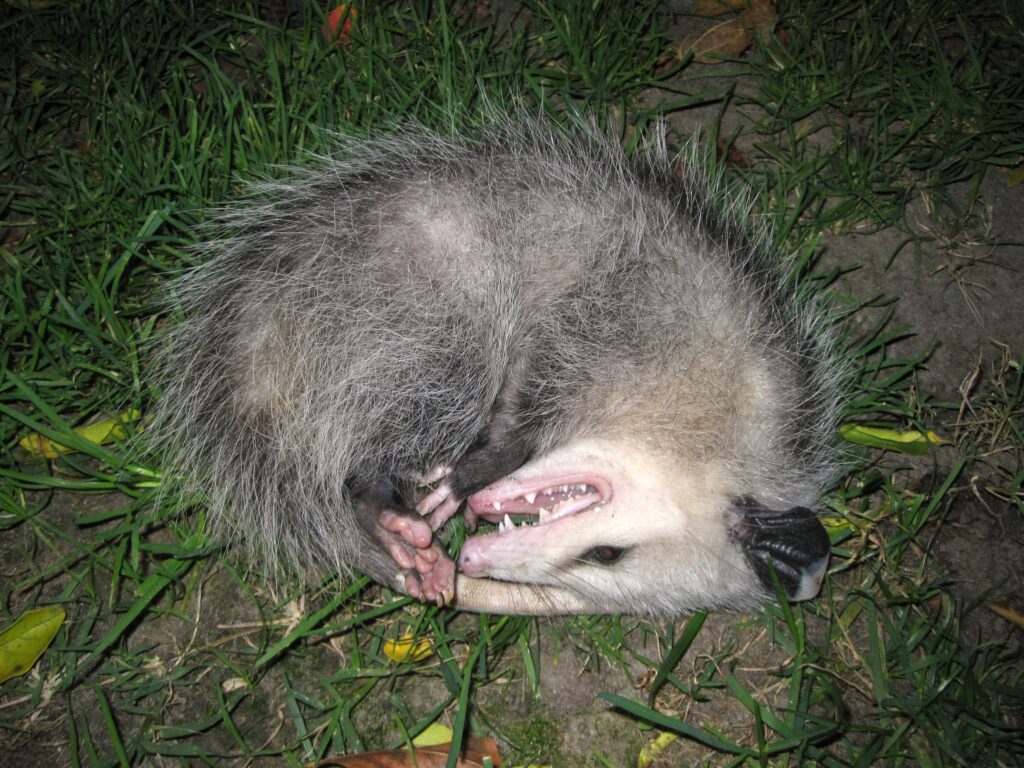
When threatened opossums will “play possum”. Their heart rate slows, and they play dead with their teeth bared, tongue hanging, and mouth foaming. A foul-smelling substance is emitted from the opossum’s anal gland, mimicking the scent of decaying flesh. Opossums can remain in this state anywhere from a few minutes to six hours. It only takes a few minutes to recover once no longer threatened.
Most predators won’t eat dead and decaying prey (unless they are scavengers), which is why playing dead helps opossums avoid predation — though it’s a relatively rare behaviour. Juvenile opossums are the post likely to play possums, whereas a threatened adult will likely stand their ground with their teeth bared, or flee.
Parasitism
The Virginia opossum is a carrier of at least 24 internal and 14 external parasites. Internal parasites include fluke worms (class Trematoda), nematodes (phylum Nematoda), and parasitic worms in the family Archiacanthocephala.
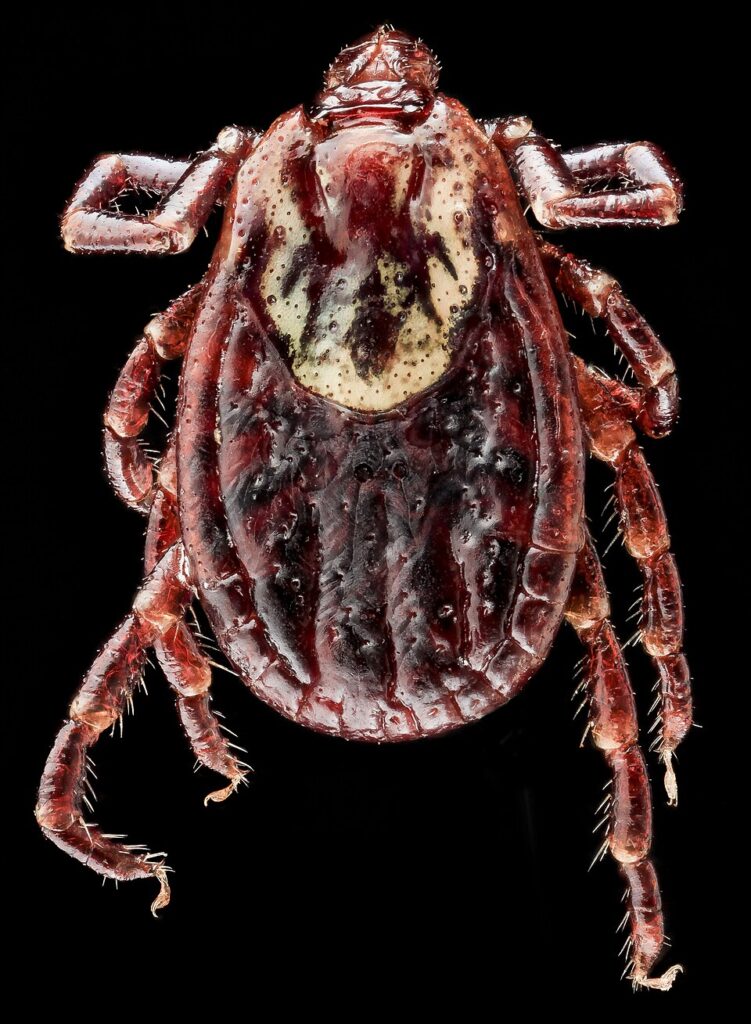
External parasites include fleas (order Siphonaptera), chiggers (family Trombiculidae), mites (genera Ornithonyssus and Marsupialichus), the American dog tick (Dermacentor variabilis) and the lone star tick (Amblyomma americanum),
Reproduction
Mating System: Polygynous (Males vie for access to reproductive females)
The Virginia opossum will have between one and three litters per year depending on range. Opossums are typically solitary, with mating being one of the only times in which they display social behaviours. Once the female has mated, she resumes her solitary lifestyle. Males do not provide any parental care.
Fun Fact: Male opossums have a bifurcated (two-headed) penis. Females, correspondingly, have bifurcated vaginal canals. This is not uncommon in marsupials.
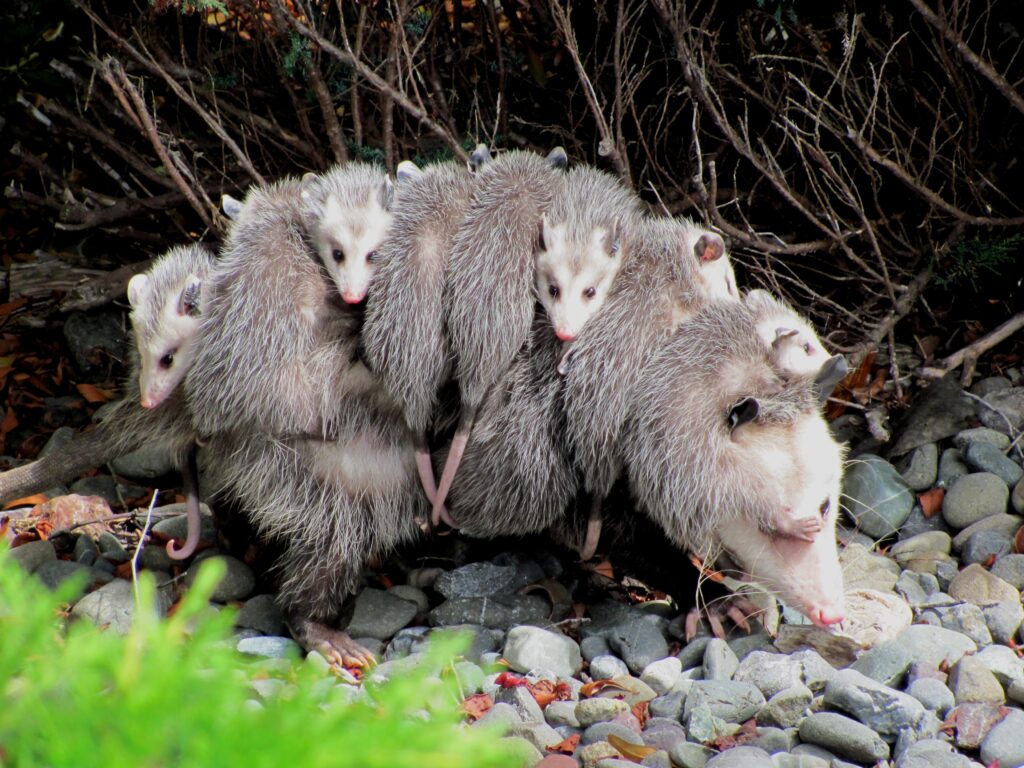
Like all marsupials, the Virginia opossum gives birth after a short gestation (12-14 days) to underdeveloped young, called joeys. Joeys are born hairless, blind, and about the size of a dime, and must wriggle their way to their mother’s marsupium — or pouch. Inside the pouch the joeys attach themselves to a nipple where they remain feeding and growing for approximately two months, at which point they are developed enough to begin venturing out into the world.
While females may be very protective of their joeys in their pouch, females show little interest in their offspring after they’ve weaned.
Niches
Both humans and habitats benefit from these nocturnal neighbours.
Opossums are important seed dispersers, helping to regenerate habitat by redistributing seeds, including seeds from the genera Asimina (pawpaws) and Diospyros (persimmon).
Scavengers like opossums provide valuable sanitation services by eating dead and decaying matter. Very few urban animals have stomach acid strong enough to digest bone and kill pathogens — but opossums do. By eating carrion and refuse opossums help prevent the spread of disease and keep our communities clean.
Tick-borne illnesses have been on the rise in Canada and the United States in recent years, and opossums are doing their part to keep ticks at bay. Opossums are excellent exterminators, eating ticks, cockroaches, mice, rats, slugs, snails, snakes, among other things. Virginia opossums kill around 95 per cent of the ticks that try feeding on them — as many as 4-thousand a week.
Conservation
The IUCN last assessed the Virginia opossum in 2016, and classed the species as Least Concern. Their populations are increasing, and they are, “common and widespread” throughout their known range. There is also no sign that populations are fragmented.
Threats
The Virginia opossum does not face any major threats. Motor vehicle collisions are the largest source of mortality for the opossum, but this is not threatening the species at large. While the opossum is hunted and trapped for food and fur within parts of its range, this practice is not endangering the species either.
Backyard Friends Video
Citations
“Virginia Opossum Didelphis virginiana.” (2016). IUCN Red List. Accessed via https://www.iucnredlist.org/species/40502/22176259
“Didelphidae Gray, 1821.” (2025). Catalogue of Life. URL: https://www.catalogueoflife.org/data/taxon/98X
Siciliano Martina, L. (2013). “Didelphis virginiana (Virginia possum).” Animal Diversity Web. Accessed via https://animaldiversity.org/accounts/Didelphis_virginiana/
Rossit, T. (2019). “Opossum.” The Canadian Encyclopedia. Accessed via https://thecanadianencyclopedia.ca/en/article/opossum
“Virginia Opossum (Didelphis virginiana).” (N.D.). National Wildlife Foundation. URL: https://nwlfd.org/species/virginia-opossum
- “Reproduction — Life Cycle.” (N.D.). Opossums Society of the United States. URL: https://opossumsocietyus.org/general-opossum-information/opossum-reproduction-lifecycle/
Austad, S. (1988). “The Adaptable Opossum.” Scientific American. URL: https://opossumsocietyus.org/wp-content/uploads/2020/03/1988-Adaptable-Opossum-Sci-Am.pdf
Duggan, G. (2020). “Opossums: These misunderstood marsupials clean up our yards and even help fight Lyme disease.” CBC News. Accessed via https://www.cbc.ca/documentaries/the-nature-of-things/opossums-these-misunderstood-marsupials-clean-up-our-yards-and-even-help-fight-lyme-disease-1.7587774
Read More

Backyard Friends: The Opossum
The Backyard Friends, a series looking at animal pals that you might find in your backyard. This segment is about the only marsupial in the U.S. and Canada — the Virginia Opossum!

Ephemeral Lakes: Fascinating Fleeting Oases
A lake is a large body of water surrounded by land and not connected to a sea or ocean… but

Kati-Thanda Lake Eyre: The Largest Lake that’s Rarely There
Kati Thanda-Lake Eyre is the largest lake in Australia when it’s full… which has only happened a few times in

