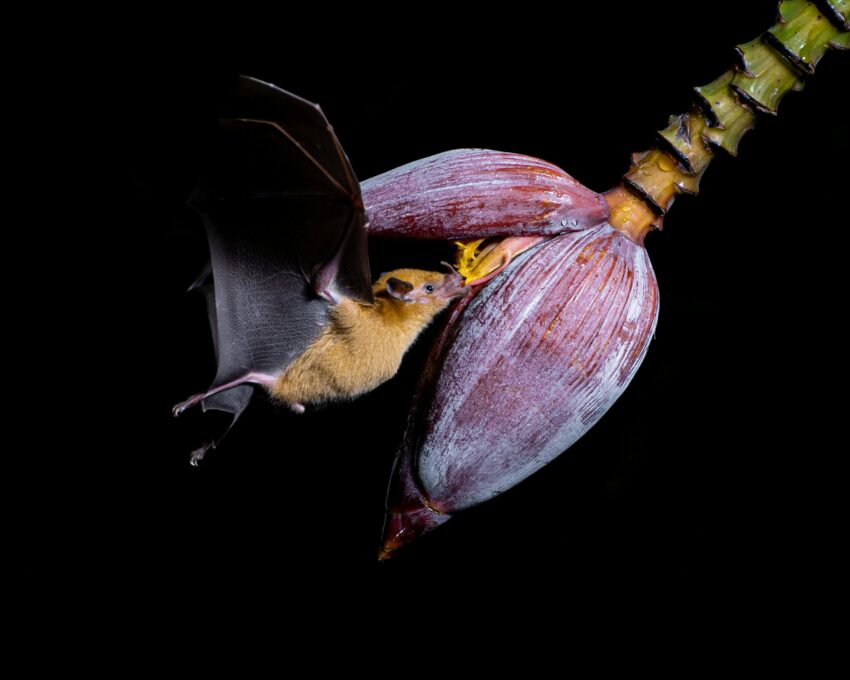
Bats play important roles in our ecosystems and economies, but they also face a variety of threats — many of them human caused — which are causing global population declines. What are the major threats to bats and what can be done to protect our flying friends.
Bats are the second most diverse order of mammals, and are found on every continent except Antarctica. They play vital roles in our ecosystems and economies by controlling insect populations, pollinating our crops, and regenerating rainforests, though they may go unnoticed or underappreciated.
In contrast, how humanity changes the environment is impossible to ignore. We alter landscapes in ways no other organism has managed, carving our name across the Earth’s surface.
Humans have modified 95 per cent of the earth’s landmass excluding Antarctica (BBC), and these changes are driving an ongoing mass extinction of species. Bats are just one of the victims of humanity’s hegemony.
My latest video explores the various threats bats face in depth.
- Frick, W.; Kingston, T.; Flanders, J. (2019). “A review of the major threats and challenges to global bat conservation.” Annals of the New York Academy of Sciences. Accessed via https://www.batcon.org/wp-content/uploads/Fricketal2019NYAS.pdf
- Voigt, C., Kingston, T. (2016). “Bats in the Anthropocene: Conservation of Bats in a Changing World.” (Individual chapters referenced in order of use). Springer Cham. Accessed via https://link.springer.com/book/10.1007/978-3-319-25220-9
- Wells, M. (2025). “Landmarks That Can Be Seen From Space: Photos.” Business Insider. Accessed via https://www.businessinsider.com/landmarks-seen-from-space-photos
- Lucchesi, E. (2022). “Earthly Objects That Can Be Seen From Space.” Discover Magazine. Accessed via https://www.discovermagazine.com/earthly-objects-that-can-be-seen-from-space-44290
- Gray, R. (2023). “How humans have changed the Earth’s surface in 2023.” BBC News. Accessed via https://www.bbc.com/future/article/20231222-how-humans-have-changed-earths-surface-in-2023
- Fox, C.; Messina, F. (2013). “Life History.” Oxford Bibliographies. Accessed via https://www.oxfordbibliographies.com/display/document/obo-9780199830060/obo-9780199830060-0016.xml
- “Bats 101.” (N.D.). Bat Conservation International. Accessed via https://www.batcon.org/about-bats/bats-101/
- Meyer, C.; Struebig, M.; Willig, M. (2016). “Chapter 4 – Responses of Tropical Bats to Habitat Fragmentation, Logging, and Deforestation.” Springer Link. Accessed via https://link.springer.com/book/10.1007/978-3-319-25220-9
- Law, B.; Park, K.; Lacki, M. (2016). “Chapter 5 – Insectivorous Bats and Silviculture: Balancing Timber Production and Bat Conservation.” Springer Link. Accessed via https://link.springer.com/book/10.1007/978-3-319-25220-9
- Williams-Guillén, K.; Olimpi, E.; Maas, B.; Taylor, P.; Arlettaz, R. (2016). “Chapter 6 – Bats in the Anthropogenic Matrix: Challenges and Opportunities for the Conservation of Chiroptera and Their Ecosystem Services in Agricultural Landscapes.” Springer Link. Accessed via https://link.springer.com/book/10.1007/978-3-319-25220-9
- “Appendices I, II and III.” (2025). CITES. Accessed via https://cites.org/eng/app/appendices.php
- Mildenstein, T.; Tanshi, I.; Racey, P. (2016). “Chapter 12 – Exploitation of Bats for Bushmeat and Medicine.” Springer Link. https://link.springer.com/book/10.1007/978-3-319-25220-9
- “Combatting Illicit Wildlife Trade and Corruption in Maritime Transport.” (N.D.). International Maritime Organization. Accessed via https://www.imo.org/en/ourwork/facilitation/pages/illicitwildlifetrade-default.aspx#:~:text=Wildlife%20trafficking%20is%20estimated%20to,counterfeit%20products%2C%20drugs%20and%20humans.
- “Wildlife Trafficking: Why battling this illicit trade is so crucial.” (2025). United States Immigration and Customs Enforcement. Accessed via https://www.ice.gov/features/wildlife
- “Stopping the Illegal Wildlife Trade.” (N.D.). The World Wildlife Fund. Accessed via https://www.wwf.org.uk/what-we-do/stopping-illegal-wildlife-trade
- Coleman, J., et al. (2024). “Dying for décor: quantifying the online, ornamental trade in a distinctive bat species, Kerivoula picta.” European Journal of Wildlife Research. Accessed via https://link.springer.com/epdf/10.1007/s10344-024-01829-9?sharing_token=cNU6zybVVsuQxIwziH5Jyve4RwlQNchNByi7wbcMAY7cnp7qWoigBPQFtBoRlzGUpcs47cEQyzWoeFH9HXebmytA8CkYiw1I-eM3Tbh52N5VQecvlpfYWfbrP8aXWYdTqc1dXWgXRI5cIF-KOwtPVmx8kf2LmBW2-Z3q8B1QAkQ%3D
- Aziz, S.; Olival, K.; Bumrungsri, S.; Richards, G.; Racey, P. (2016). “Chapter 13 – The Conflict Between Pteropodid Bats and Fruit Growers: Species, Legislation and Mitigation.” Springer Link. Accessed via https://link.springer.com/book/10.1007/978-3-319-25220-9
- Kingston, T., Florens, V., Oleksy, R., Ruhomaun, K. & Tatayah, V. (2017). “Pteropus niger, Greater Mascarene Flying Fox.” IUCN Red List of Threatened Species. Accessed via https://www.google.com/url?sa=t&source=web&rct=j&opi=89978449&url=https://www.iucnredlist.org/species/pdf/86475525&ved=2ahUKEwjf66iK0ZKQAxX4OjQIHZ_EGh8QFnoECBgQAQ&usg=AOvVaw2-4RSm5y2FHK4xh4gfJ52Y
- Waldien, D. (2015). “Re: Bat Conservation International’s Position on the proposed control of Mauritius Fruit Bats Pteropus niger.” Bat Conservation International. Accessed via https://www.batcon.org/files/BCI_MauritiusBat_Culling_20152.pdf
- Furey, N.; Racey, P. (2016). “Chapter 15 – Conservation Ecology of Cave Bats.” Springer Link. Accessed via https://link.springer.com/book/10.1007/978-3-319-25220-9
- Chiarini, V., Duchkeck, J., De Waele, J. (2022). “A Global Perspective on Sustainable Show Cave Tourism.” Geoheritage. Accessed via https://pmc.ncbi.nlm.nih.gov/articles/PMC9244007/
- “Population.” (N.D.). United Nations. Accessed via https://www.un.org/en/global-issues/population#:~:text=Day%20of%20Eight%20Billion,are%20in%20sub%2DSaharan%20Africa.
- “Urban Development.” (N.D.). World Bank Group. Accessed via https://www.worldbank.org/en/topic/urbandevelopment/overview#:~:text=Building%20more%20livable%20cities%20is,people%20will%20live%20in%20cities.
- Jung, K.; Threlfall, C. (2016). “Chapter 2 – Urbanisation and Its Effects on Bats ⸺ A Global Meta-Analysis.” Springer Link. Accessed via https://link.springer.com/book/10.1007/978-3-319-25220-9
- Aronson, M., et al. (2014). “A global analysis of the impacts of urbanization on bird and plant diversity reveals anthropogenic drivers.” The Royal Society Publishing. Accessed via https://pmc.ncbi.nlm.nih.gov/articles/PMC4027400/
- Kunnari, M. (2020). “The American Lawn.” ARCGIS. Accessed via https://storymaps.arcgis.com/stories/6730610a287e459a84f0c04f74ad8cb2
- Sotelo, G. (2022). “What is the Difference Between Native, Non-native, and Invasive Plants?” The Audubon Society. Accessed via https://www.audubon.org/news/what-difference-between-native-non-native-and-invasive-plants
- Altringham, J.; Kerth, G. (2016). “Chapter 3 – Bats and Roads.” Springer Link. Accessed via https://link.springer.com/book/10.1007/978-3-319-25220-9
- Furey, N.; Racey, P. (2016). “Chapter 15 – Conservation Ecology of Cave Bats.” Springer Link. Accessed via https://link.springer.com/book/10.1007/978-3-319-25220-9
- “Karst.” (N.D.). National Geographic. Accessed via https://education.nationalgeographic.org/resource/karst/
- Snell, G. (2021). “Teeming with life, the destruction of Vietnam’s karsts hits biodiversity.” Southeast Asia Globe. Accessed via https://southeastasiaglobe.com/karst-forest-limestone-mining-vietnam/
- “Share of electricity production from wind, 2024.” (2024). Our World in Data. Accessed via https://ourworldindata.org/grapher/share-electricity-wind
- Arnett, E.; Baerwald, E.; Mathews, F.; Rodrigues, L.; Rodríguez-Durán, A.; Rydell, J.; Villegas-Patraca, R.; Voigt, C. (2016). “Chapter 11 – Impacts of Wind Energy Development on Bats: A Global Perspective.” Springer Link. Accessed via https://link.springer.com/book/10.1007/978-3-319-25220-9
- Frick, W.; Puechmaille, S.; Willis, C. (2016). “Chapter 9 – White-Nose Syndrome in Bats.” Springer Link. Accessed via https://link.springer.com/book/10.1007/978-3-319-25220-9
- Snowden, W. (2025). “Inside the Bat Cave.” CBC News. Accessed via https://www.cbc.ca/newsinteractives/features/cadomin-cave-Alberta-bats-white-nose-syndrome
- “White-Nose Syndrome Killed Over 90% of Three North American Bat Species.” (2021) U.S. Geological Survey.Accessed via https://www.usgs.gov/news/national-news-release/white-nose-syndrome-killed-over-90-three-north-american-bat-species
- Wynne, J. (2017). “Appendix III. Procedures prior to entering and after exiting a cave or mine.” U.S. National Park Service. Accessed via https://www.nps.gov/articles/parkscience33-1_61_wynne_appendix_iii_3858.htm
- “Clean Caving Procedures.” (N.D.). Save Your Caves. Accessed via https://www.saveyourcaves.org/learn/clean-caving.html
- Hormick, P. (2025). “Why Cats and Bats Don’t Mix.” Bat Conservation International. Accessed via https://www.batcon.org/why-cats-and-bats-dont-mix/
- Oedin, M.; Brescia, F.; Millon, A.; Murphy, B.; Palmas, P.; Woinarski, J.; Vidal, E. (2021). “Cats Felis catus as a threat to bats worldwide: a review of the evidence.” Mammal Review. Accessed via https://onlinelibrary.wiley.com/doi/10.1111/mam.12240
- “Land Pollution.” (N.D.). National Geographic. Accessed via https://education.nationalgeographic.org/resource/pollution/
- Rowse, E.G.; Lewanzik, D.; Stone, E.L.; Harris, S.; Jones, G. “Chapter 7 – Dark Matters: The Effects of Artificial Lighting on Bats.” Springer Link. Accessed via https://link.springer.com/book/10.1007/978-3-319-25220-9
Read More
Backyard Friends: The Virginia Opossum
The Backyard Friends is a series looking at animal pals that you might find in your backyard. This segment is about the only marsupial in the U.S. and Canada — the Virginia Opossum!
Ephemeral Lakes: Fascinating Fleeting Oases
A lake is a large body of water surrounded by land and not connected to a sea or ocean… but
Kati-Thanda Lake Eyre: The Largest Lake that’s Rarely There
Kati Thanda-Lake Eyre is the largest lake in Australia when it’s full… which has only happened a few times in